
Quick Cheat Sheet: 3 Things Every Beginner Must Know
The core objective is to predict which hand finishes closest to a point sum of 9
Face cards and 10s count strictly as 0 points; only the rightmost single digit counts.
Betting on Banker features the lowest house edge (~1.06%), making it statistically optimal.
Introduction: Debunking the High-Roller Exclusivity Myth
Often portrayed in cinematic fiction as the sequestered pastime of tuxedo-clad aristocrats and clandestine high-stakes gamblers, baccarat (historically known as Punto Banco in European gaming salons) is paradoxically one of the simplest, fairest, and most democratic card games on any modern casino floor.
Originating between Italy and 15th-century French courts before taking firm institutional root in Monte Carlo, London, and Valletta, baccarat eliminated player error by design. Unlike poker or blackjack, there are no complicated multi-page strategy charts to commit to memory, no split-second hit-or-stand dilemmas under peer pressure, and zero bluffing psychology.
Once you position your chips, the licensed croupier operates under an immutable set of procedural mandates governing every draw. Statistically, baccarat offers some of the thinnest house advantages in gaming jurisprudence, rendering it an ideal starting point for beginners exploring licensed Mediterranean gaming destinations.
The Fundamental Objective & Table Layout
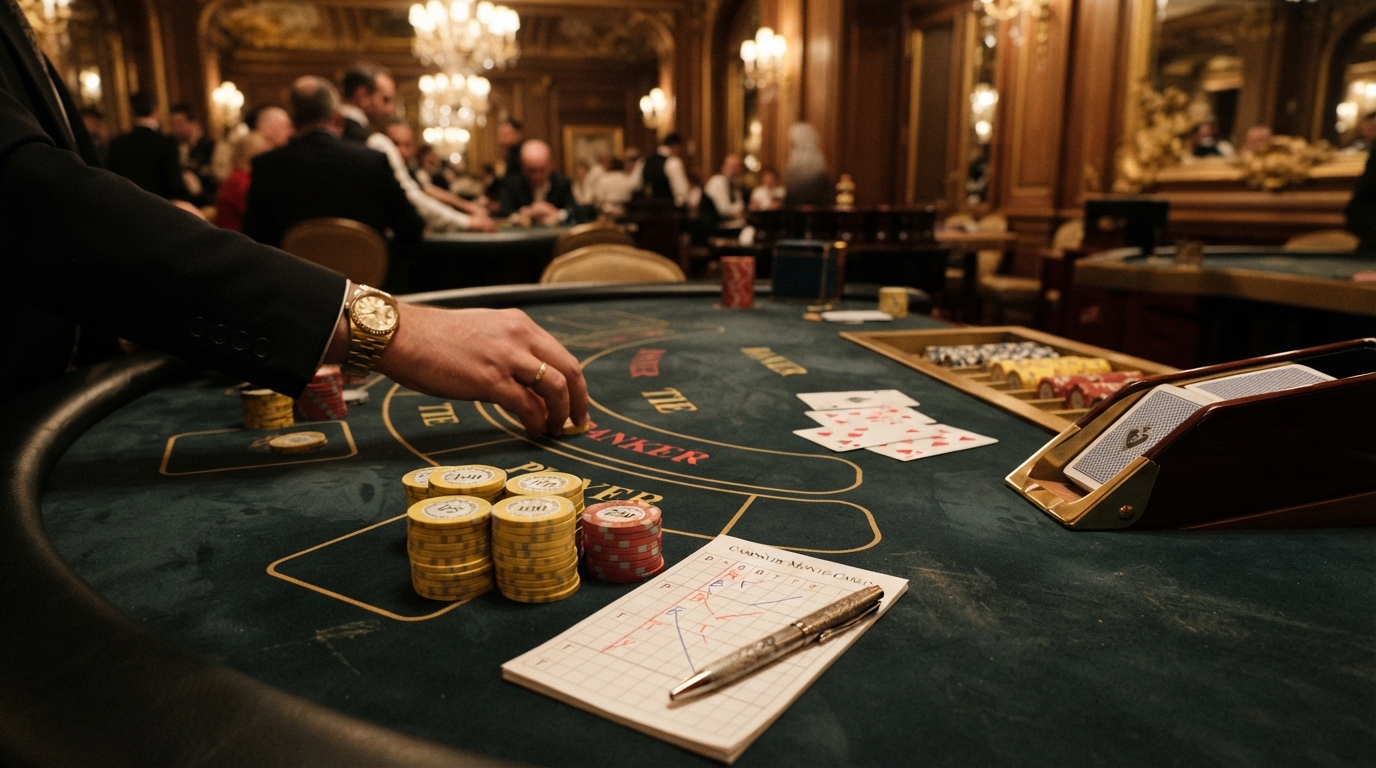
In standard Punto Banco, only two hands are dealt on the felt during any given round: the Player Hand (Punto) and the Banker Hand (Banco). It is essential to recognize that these terms do not represent you or the house. They are simply arbitrary labels for two competing card outcomes.
Player Sector (Punto)
The designated betting box predicting the Player hand total will finish closer to 9 than the Banker.
Banker Sector (Banco)
The designated box predicting the Banker hand will triumph. Holds the mathematical edge across multi-deck shoes.
Tie Sector (Egalité)
Predicts both sides will finish with identical scores. If a tie occurs and you wagered on Player or Banker, bets are refunded (push).
Cards are dealt from an acrylic or wooden dealing shoe containing either 6 or 8 standard 52-card decks shuffled in compliance with Malta Gaming Authority (MGA) inspection standards.
The Point System & Card Valuation in Depth
Card valuation in baccarat differs significantly from traditional games like poker or blackjack. Suits (Spades, Hearts, Diamonds, Clubs) hold zero significance; only the numeric denominations dictate the coup.
Universal Card Values Breakdown
style
Always counted as 1 point.
filter_7
Counted exactly as printed on the pip.
hourglass_empty
Known as "Baccara" (meaning zero).
The Drop-the-Tens Rule (Modulo 10 Arithmetic)
Because hand totals cannot exceed 9, any two-digit sum has its tens digit dropped immediately:
Step-by-Step Anatomy of a Coup (Round of Play)
Every deal unfolds in four disciplined operational phases:
Step 1: Place Your Wager
Before the croupier calls "Rien ne va plus" (no more bets), position your chips in the Player, Banker, or Tie box. Minimums on European tables typically range between €10 and €25.
Step 2: The Initial Two-Card Deal
The croupier pulls four cards from the shoe face-up in alternating sequence: first card to Player, second to Banker, third to Player, fourth to Banker.
Step 2: The Initial Two-Card Deal
If either position totals an 8 or 9 on the initial deal, the coup concludes immediately as a "Natural." No auxiliary cards are drawn, winning wagers are disbursed, and lost bets are collected.
Step 4: The Third-Card Drawing Tableau
If neither hand has a natural, the fixed rules dictate third-card additions. As a player, you make zero decisions here; the dealer administers the following matrix automatically:
The Standard Third-Card Drawing Rules (Tableau)
| Banker Hand Total | Banker Draws When Player’s 3rd Card Is: | Banker Stands When Player’s 3rd Card Is: |
|---|---|---|
| 0, 1, or 2 | Always draws a third card | — |
| 3 | 0, 1, 2, 3, 4, 5, 6, 7, 9 | 8 |
| 4 | 2, 3, 4, 5, 6, 7 | 0, 1, 8, 9 |
| 5 | 4, 5, 6, 7 | 0, 1, 2, 3, 8, 9 |
| 6 | 6, 7 (Only if Player drew) | 0, 1, 2, 3, 4, 5, 8, 9 |
| 7 | — | Always stands on 7 |
| 8 or 9 | — | Natural hands — No cards drawn |
Mathematical Truths, House Edges & Commission Mechanics
Because Banker acts with positional advantage based on what card Player drew, Banker wins slightly more frequently over large sample sizes: 45.86% of hands, against 44.62% for Player and 9.52% for Ties.
Traditional Commission vs. "No Commission" (Super 6 / Punto 2000)
In some modern salons, casinos market "Commission-Free Baccarat" where winning Banker bets pay 1:1. However, if the Banker wins specifically with a total of 6, payouts are halved to 50% (or 0.5:1). This rule tweak quietly elevates the house edge from 1.06% to 1.46%, making traditional 5% commission tables mathematically superior.
Mediterranean & Maltese Casino Table Etiquette
Licensed Maltese gaming rooms pride themselves on an approachable atmosphere, yet adherence to international floor etiquette guarantees an effortless visit:
Purchasing Chips on the Felt
Never hand Euro banknotes directly into dealer hands. Place notes flat on the felt between active hands. The dealer slides notes through optical verification scanners and exchanges corresponding chips.
Hands-Off Protocol (Midi & Mini)
At standard European Punto Banco tables, guests never touch cards. Only licensed croupiers manipulate the tableau to ensure full procedural surveillance under MGA compliance.
Croupier Inquiries
Croupiers in Malta speak fluent English and Italian and are trained to explain complex third-card draws. Inquiring politely about hand totals is welcomed.
Fixed Bankroll Allocation
Divide your evening leisure budget into distinct wagering units. At a €10 minimum table, starting with 20 to 25 units (€200–€250) prevents quick depletion from normal table variance.
Bankroll Discipline & Understanding Electronic Roadmaps
Virtually every baccarat table features an electronic overhead screen exhibiting intricate red, blue, and green grids commonly termed The Big Road, Bead Plate, or Cockroach Pig.
The Gambler's Fallacy on Trend Boards
While tracking previous streaks is an enjoyable social ritual for players, mathematics proves that every coup remains statistically independent. A shoe showing six consecutive Banker wins has no memory; the subsequent card draw retains identical underlying probabilities. Establish rigid stop-loss boundaries before beginning play and never double down to chase losses.