
Hospitaller Malta & The Early Games of Noble Chance
The narrative of leisure, probability, and high-stakes gamesmanship across the Maltese archipelago does not originate in contemporary data centres or 20th-century resort developments. Rather, it is deeply embedded in the chivalric and mercantile fabric of the Sovereign Military Order of St. John of Jerusalem, Rhodes, and Malta. Following the Order’s installation on the island in 1530 after their expulsion from Rhodes by Suleiman the Magnificent, the rocky Mediterranean bastion became home to thousands of European aristocratic younger sons. These noble knights brought with them not only their martial traditions, vast familial annuities, and continental diplomatic connections, but also the refined gambling customs of the Italian, French, and Castilian courts.
Within the opulent auberges of the Collachio in Birgu, and later along the rectilinear limestone boulevards of Valletta after the Great Siege of 1565, private gaming assemblies flourished behind closed doors. Games such as Bassette (a predecessor of Baccarat that originated in Venice), Pharaon (Faro), and elaborate variations of hazard dice were played routinely. Because these games involved significant exchanges of silver scudi, Spanish reals, and gold zecchini, they repeatedly threatened to destabilise both military discipline and clerical decorum within the monastic state.
"Let no brother or knight wager an amount exceeding ten scudi in a single solar cycle upon the roll of dice or the draw of cards, lest his horse and livery be confiscated to the common treasury of the Sacra Infermeria."
Decrees of this nature were frequently re-issued by successive Grand Masters, notably Jean de La Cassière and Manuel Pinto da Fonseca, demonstrating both the persistence of high-stakes play among European nobility in Valletta and the early emergence of administrative gaming oversight.
During the reign of Grand Master Emmanuel de Rohan-Polduc in the late 18th century, the pragmatic reality of wagering became codified. Recognising that outright prohibition drove gambling into illicit maritime taverns around the Grand Harbour, the Order began systematically taxing and monitoring assembly halls (known locally as ridotti), where gentlemen of distinction and visiting naval commanders engaged in Faro and cards under state surveillance. This marked the earliest conceptual precedent for institutionalised, state-supervised gaming in Malta.
The British Colonial Period: The Birth of The National Lottery
With the arrival of British administration following the expulsion of Napoleonic forces at the dawn of the 19th century, the legal and operational approach to wagering underwent radical structural modernisation. The British authorities brought with them strict Common Law attitudes toward public order, yet they quickly recognised the deep-rooted cultural appetite for games of chance among the Maltese populace—most notably the traditional Italian-style lotto, which had been popularised through Sicilian commerce.
Throughout the 19th century, unregulated numbers lotteries operated in informal networks across urban towns such as Floriana, Cospicua, and Rabat. Recognising both the public risks of unregulated operators and the fiscal opportunity for municipal revenue, the colonial civil service drafted pioneering legislative instruments. This culminated in the landmark Public Lotto Ordinance of 1922, an essential milestone that established the Public Lotto Department.
1922
Transformed street wagering into a state-regulated institution with dedicated draws.
1934
The inaugural draw of the National Lottery generated funds for hospitals and municipal works.
1948
Dedicated lotto revenues rebuilt bombed harbour infrastructure following WWII.
The Public Lotto Department introduced strict balloting procedures, mathematically verified payout brackets, and certified public tombola operations. Every Saturday, public draws in Valletta drew large crowds to witness the extraction of wooden lotto balls from brass cages under judicial oversight. The colonial government channelled these gaming revenues directly into healthcare facilities, harbour dredging, and social welfare programs, codifying the doctrine that licensed gaming must deliver a tangible societal return.
Why Did Malta Become a Major iGaming Hub?
Malta's emergence as an international iGaming hub was driven by its early adoption of remote gaming regulations in 2004, its established legal and business environment, and the growth of specialised technology and compliance services. These factors helped attract gaming operators, software providers, and industry professionals.
Malta's regulatory framework continued to evolve through the Gaming Act of 2018, which strengthened supervisory and enforcement capabilities. Today, the Malta Gaming Authority oversees licensing and regulatory compliance, making regulation a central part of the country's gaming industry.
The Dragonara Legacy & Mid-Century Coastal Grandeur
As Malta approached its independence from the United Kingdom in September 1964, the national economic imperative shifted decisively toward tourism diversification and European diplomacy. Prime Minister George Borg Olivier’s administration recognised that to compete with Monte Carlo, Cannes, and Sanremo, Malta needed an iconic, world-class entertainment venue that reflected Mediterranean architectural splendour.
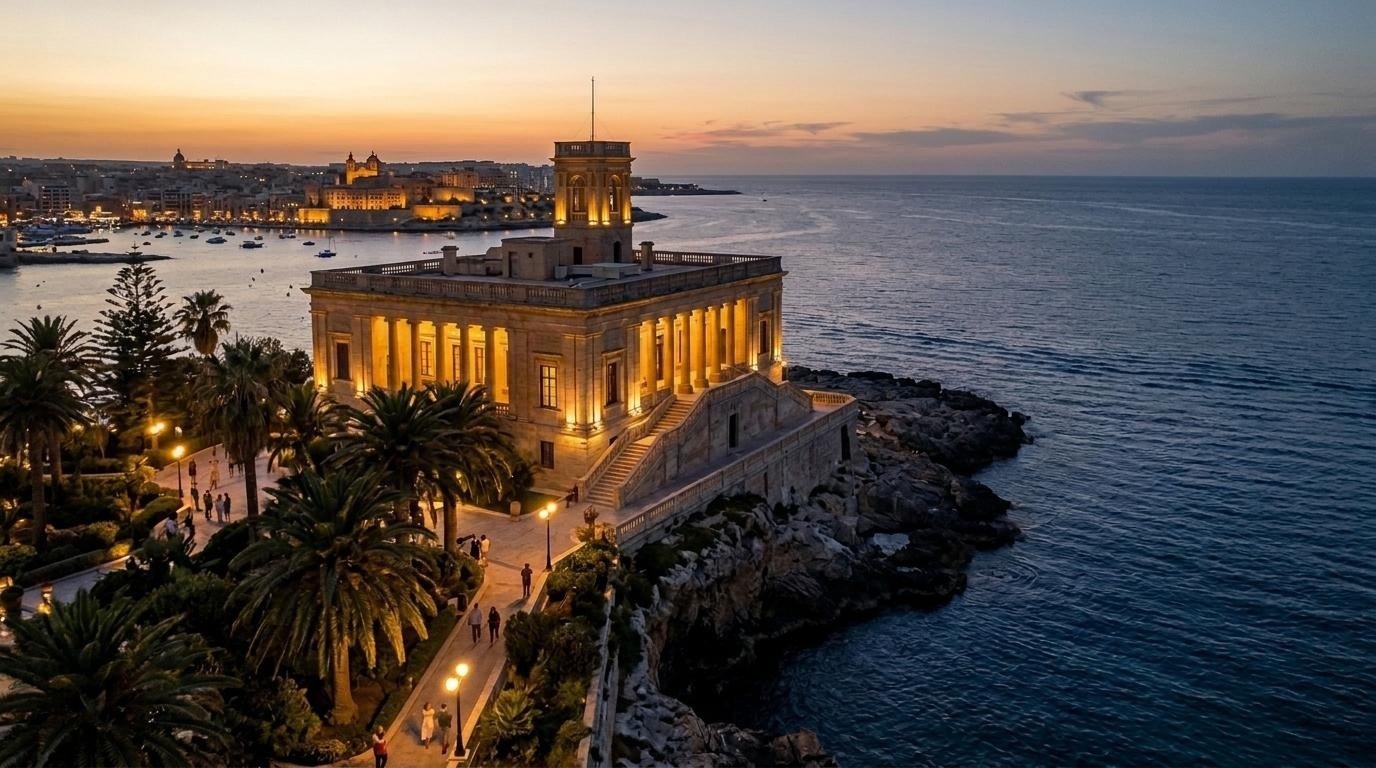
The ideal setting was discovered on the dramatic limestone promontory of St. Julian’s Point. Built in 1870 as an opulent summer villa for the Marquis Emanuele Scicluna—one of Malta’s wealthiest bankers—the Palazzo Dragonara combined classical neoclassical colonnades with expansive gardens, looking directly out over the open Mediterranean. On July 15, 1964, following meticulous restoration and the installation of custom French roulette wheels and American craps tables, the Dragonara Casino officially opened its doors.
Discover how Malta’s historic gaming venues combine architectural heritage with modern casino entertainment in our guide, The Architecture of Chance: Inside Malta’s Historic Casinos & Modern Play.
A Continental Destination for European Royalty
Throughout the 1960s and 1970s, the Dragonara attracted European aristocracy, British film stars, and shipping magnates. Formal black-tie dress codes were strictly enforced; French croupiers were flown in from Nice and Biarritz to train the first generation of Maltese table managers, establishing an enduring standard of hospitality and gaming integrity.
The success of the Dragonara proved that Malta could host prestigious international gaming while preserving safety and decorum. It served as the foundation for the island's subsequent modern venues, including the Oracle Casino in Bugibba, the Casino Malta complex in St. Julian's, and the Portomaso Casino overlooking the marina.
The 2004 Regulatory Revolution: The Lotteries and Other Games Act
While land-based casinos flourished as pillars of the luxury tourism sector, the arrival of the 21st century brought a seismic disruption in international commerce: the internet. While most European jurisdictions viewed remote digital gaming with apprehension or enacted rigid state monopolies, Malta adopted an audaciously progressive, legally rigorous approach.
In 2004, coinciding precisely with Malta’s formal accession to the European Union, the government enacted the pioneering Remote Gaming Regulations under the broader Lotteries and Other Games Act (Cap. 438). With this single legislative stroke, Malta became the first EU member state to establish a comprehensive regulatory framework for online gaming.
- verified_user Ring-Fenced Player Funds: Operators were legally mandated to keep player deposits strictly separated from corporate operating balances in designated Tier-1 European accounts.
- developer_board Independent Software Certification: Random Number Generators (RNG) and return-to-player (RTP) algorithms required independent laboratory verification prior to deployment.
- assured_workload Creation of the LGA (Now MGA): A dedicated regulatory body was empowered with criminal investigative reach, on-site audit authority, and unilateral licence revocation powers.
This regulatory certainty proved irresistible to major Scandinavian, British, and continental iGaming companies. Rather than operating from remote offshore jurisdictions with ambiguous legal standing, companies could secure an EU-recognized license from Malta, providing credibility to players, payment processors, and European banking institutions.
For more information about the evolution of Malta’s gaming legislation and licensing framework, refer to the official Malta Gaming Authority regulatory framework.
The Modern Global Ecosystem: Tech Infrastructure, Talent & Capital
Regulation alone could not sustain Malta’s ascendancy without corresponding investments in telecommunications, human capital, and international financial services. Over two decades, Malta developed an interconnected economic cluster tailored to the operational demands of digital gaming enterprises.
Subsea submarine fibre-optic cables connecting the island directly to Sicily, mainland Italy, and Marseille provided the ultra-low latency and redundant failover capacity required for real-time sports wagering and live-dealer casino feeds. Specialist enterprise data centres emerged across SmartCity Malta, Birkirkara, and Luqa, adhering to ISO 27001 cybersecurity certifications.
From tier-1 sportsbooks to slot development studios and AI fraud detection platforms.
Representing over 8% of the full-time national workforce across legal, compliance, and product engineering.
Consistently serving as one of Malta’s core tertiary economic drivers alongside financial services and aviation.
Over 50 nationalities reside in the St. Julian’s and Sliema urban corridor, powering 24/7 European market operations.
Today, Malta hosts major global gaming conferences such as SiGMA, drawing over 25,000 international delegates annually. What began as an experimental regulatory initiative in 2004 has matured into an entrenched economic sector that continues to shape technological innovation and European legal discourse Understanding Casino House Edge.
Modern Player Safeguards & The European Gold Standard
In 2018, the Malta Gaming Authority enacted the sweeping Gaming Act (Act No. VIII of 2018), replacing the outdated licensing categorisations with a streamlined two-tier framework: Business-to-Consumer (B2C) and Business-to-Business (B2B) licences. Crucially, the 2018 reforms placed consumer protection, responsible gaming architecture, and anti-money laundering (AML) controls at the very centre of an operator's licence condition.
Under modern MGA statutes, licensed operators must deploy automated algorithmic pattern detection to flag potential problem gambling indicators. Players have mandatory access to deposit limits, cooling-off periods, and direct access to self-exclusion databases that synchronize across multiple operator environments.
To understand the current licensing requirements, regulatory obligations, and player protection standards, readers can consult the official Malta Gaming Authority regulatory framework.
Every casino operating within Maltese physical territory or operating under remote B2C authorisation is bound by European Union 5th Anti-Money Laundering Directive (5AMLD) guidelines, stringent Know-Your-Customer (KYC) identity verifications, and regular contributions to the Responsible Gaming Foundation (RGF).
Learn how to manage your casino budget effectively with our bankroll management guide.
Key Milestones in Malta's Gaming History
- 1530–1798: Rule of the Knights of St. John and Malta’s early gaming traditions.
- British colonial period: Development of lottery administration and public regulation.
- 1964: Dragonara Casino becomes a major landmark in Malta’s casino tourism.
- 2004: Malta introduces its remote gaming regulatory framework.
- 2018: Malta’s new Gaming Act modernises licensing and regulatory oversight.
- 2025–2026: Malta continues developing its regulated gaming industry, with increasing emphasis on compliance and player protection.
Frequently Asked Questions
Essential answers regarding the legal history, licensing structures, and current operations of the Maltese gaming jurisdiction.
When did gambling become formally legal in Malta?
While informal and private noble games were practiced throughout the Hospitaller period (1530–1798), the formal statutory legalisation and state regulation of gaming occurred under British colonial rule with the Public Lotto Ordinance of 1922. Modern brick-and-mortar casino gaming was legalized in the early 1960s, leading to the opening of the Dragonara Casino in July 1964.
Why did Malta become the premier capital of European remote gaming?
Malta was the first European Union member state to introduce comprehensive, clear regulations for remote online gaming in 2004. This early legislative foresight, combined with high-speed subsea connectivity, an English-speaking commercial legal system, competitive corporate tax frameworks, and access to the European single market, attracted the world's leading gaming software providers and consumer operators.
What is the constitutional role of the Malta Gaming Authority (MGA)?
The Malta Gaming Authority is the single regulatory body responsible for the governance of all commercial gaming activities in Malta, encompassing land-based casinos, national lotteries, amusement machines, and remote iGaming operators. Its mandate encompasses licensing verification, auditing RNG software, protecting minors and vulnerable individuals, preventing money laundering, and safeguarding consumer balances.
Can visitors tour Malta's historic gaming palazzos?
Yes. Active historical venues such as the Dragonara Palace in St. Julian's are open to the adult public (18+ for foreign passport holders, 25+ for Maltese citizens as per national gaming statute). Visitors may experience the neoclassical colonnades, waterfront gardens, and period architecture while observing standard casino etiquette and international dress codes.
Executive Key Takeaways: Malta’s Gaming Evolution
Centuries of Aristocratic Heritage
Modern Maltese gaming stands on five centuries of aristocratic play under the Knights of St. John and structured colonial lottery statutes under British governors.
The Dragonara Benchmark (1964)
The conversion of 19th-century private palazzos into world-class casinos anchored Malta’s luxury hospitality sector during the mid-20th century.
First-Mover EU Advantage (2004)
Pioneering statutory regulations in 2004 established Malta as the trusted benchmark for European remote gaming oversight.
Economic Cornerstone
The industry directly contributes approximately 6.3% to Malta's GDP, employing more than 19,150 specialised professionals across compliance, product development, and finance.
Uncompromising Player Protection
Contemporary frameworks mandate segregated funds, automated anti-money laundering reporting, and support through the 1777 national helpline.