
The Palazzo Paradigm: Sovereignty, Stone, and High Society
When European leisure culture expanded across the southern littoral in the late Victorian and Edwardian eras, gaming spaces were rarely conceived as indiscriminate entertainment sheds. In Malta, the geography itself dictated a dramatic architectural cadence. Set upon limestone headlands sculpted by centuries of naval fortification, the island's earliest dedicated gaming spaces evolved inside aristocratic residences and seaside summer retreats.
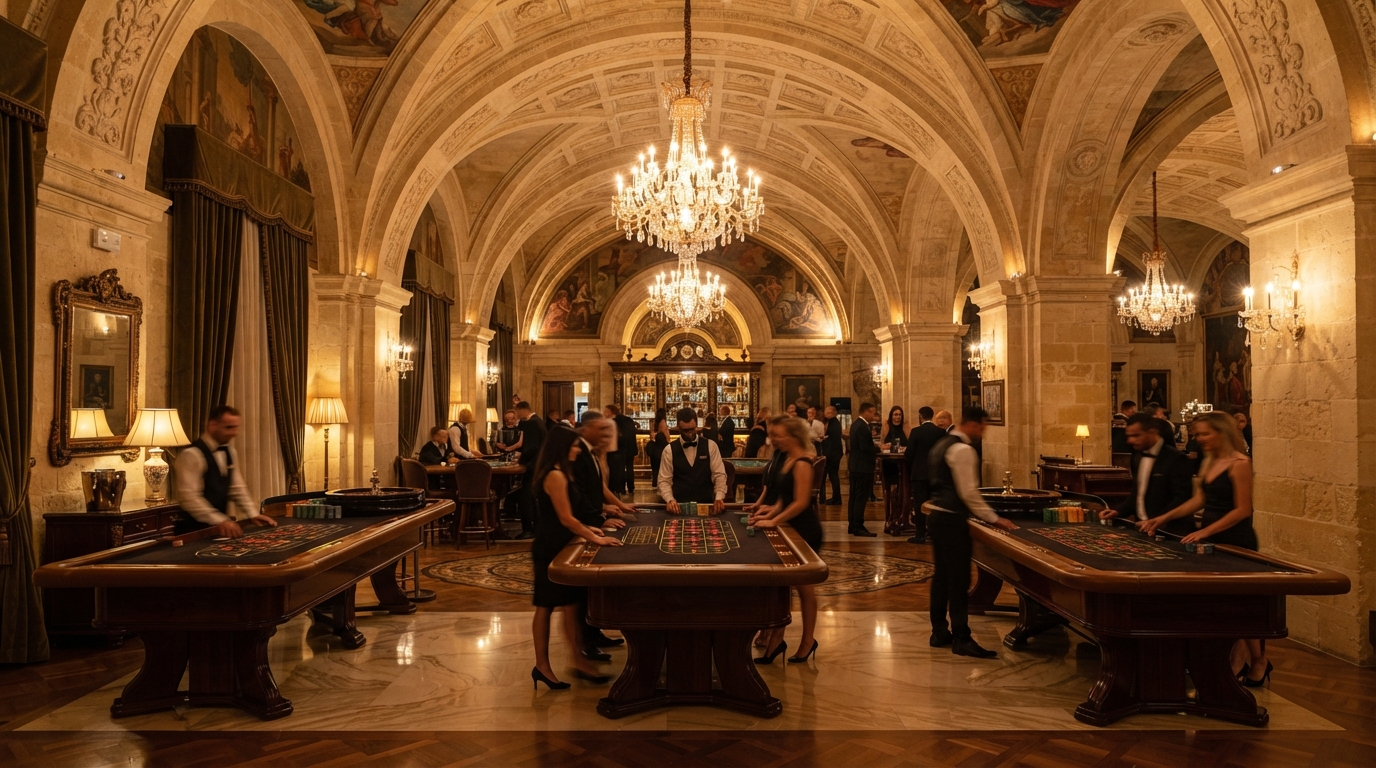
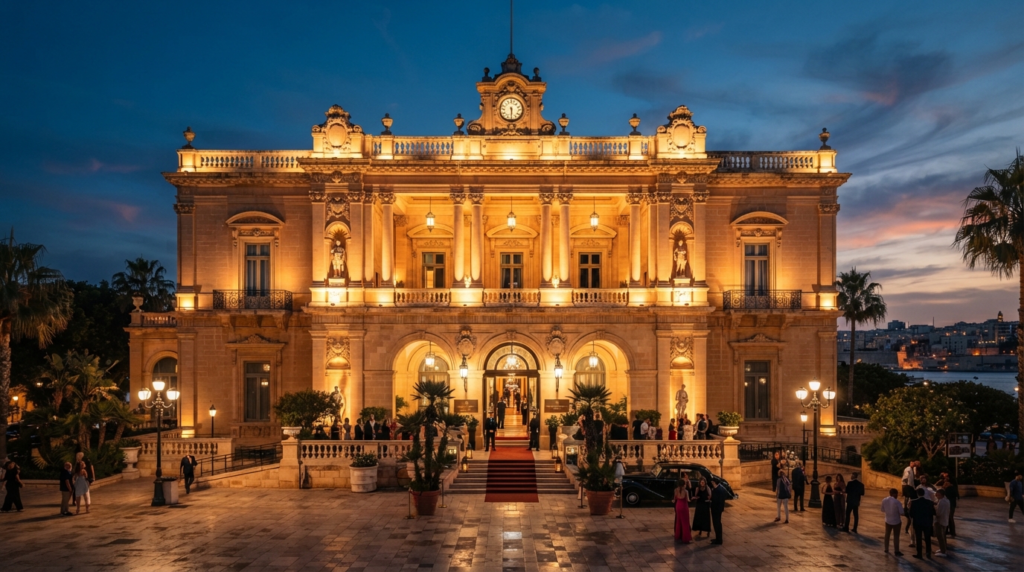
The quintessential manifestation remains the Dragonara Palace, erected in 1870 as the private summer residence of the Marquis Scicluna. Designed with colonnaded verandas that wrap tightly around a fortified peninsula, the structure was specifically calculated to catch the nocturnal Mediterranean mistral while enclosing gaming tables inside vaulted, high-ceilinged saloons. To understand how venues such as Dragonara fit into the island’s broader gaming heritage, explore our guide to the history of gambling in Malta. Here, globetrotters, visiting British naval officers, and continental diplomats gathered under stuccoed ceilings where the chime of ivory balls against mahogany roulette cylinders resonated with an almost domestic intimacy.
According to Dragonara Casino’s official history, the palace was built in 1870 as a summer residence for the Scicluna family. It later became home to Malta’s first casino in 1964.
Unlike modern commercial complexes that disorient the patron through labyrinthine pathways, historic Maltese gaming architecture was strictly axial. Salons opened directly onto grand courtyards and open loggias. The sea was never banished from view; rather, the rhythmic sound of crashing waves provided a natural acoustic white noise, insulating individual salons from public scrutiny while creating an atmosphere of sovereign privacy. This maritime setting preserved the dignity of high-stakes play, contrasting starkly with the cloistered, windowless vaults that emerged in inland European capitals during the mid-20th century.
"The historic Maltese gaming salon was conceived as a theater of aristocratic composure: lofty timber-trussed ceilings, cross-ventilating sea terraces, and stone mass that absorbed tension as gracefully as it resisted the Mediterranean heat."
Acoustic Fields, Illumination, and the Cognitive Ecology of the Salon
The physical environment of any gaming floor operates as an unwritten psychological contract. Every ambient element—the decay time of acoustic reverberation, the Kelvin temperature of overhead downlights, the spatial volume allocated to each patron—subtly steers focus, dignity, and longevity of engagement.
In classical Maltese salons, limestone walls measuring up to a meter in thickness provide massive acoustic dampening. Low-frequency conversational murmur is absorbed, preventing the cacophony common in steel-and-drywall modern halls. To this day, master floor planners in Malta balance this natural stone resonance with hand-woven wool carpets and felt-topped gaming tables. The result is a sound profile where dealer announcements carry with clarity without demanding elevated vocal volume, fostering an aura of calm calculation.
Illumination within Malta's premier venues similarly rejects the harsh glare of modern retail. Downward-focused pendant lamps cast an exact, warm illumination (calibrated between 2,700K and 3,000K) directly onto the green and burgundy baize surfaces, while leaving patrons' facial expressions in gentle, respectful half-light. This directional concentration minimizes ocular fatigue over multi-hour sessions and anchors the player's cognitive field directly to the tactical geometry of the cards or wheel.
The Regulatory Matrix: MGA Standards and Floor Blueprint Evolution
Malta's emergence as the primary regulatory capital of European iGaming under the stewardship of the Malta Gaming Authority (MGA) fundamentally reshaped physical casino layouts. While the island's online framework garnered global recognition, its land-based commercial regulations remain among the most rigorous in the European Union.
Under MGA directives, a casino's architectural layout is not merely an aesthetic consideration—it is a legal instrument. Blueprints must establish uninhibited line-of-sight corridors for floor supervisors, known in operational parlance as "pit sightlines." The distance between active live gaming tables must meet minimum clearance thresholds to ensure that floor inspectors and surveillance cameras maintain an unoccluded overhead view of chip trays, drop boxes, and card shoes at all times.
Furthermore, the architectural floor is strictly stratified into distinct regulatory operational zones:
The entrance vestibule is physically severed from the active gaming floor. Here, biometric passport scanning, national exclusion database checks (Responsible Gaming Foundation), and age verification take place in an ambient, welcoming reception lounge before a patron crosses the operational barrier.
Wide concourses housing electronic roulette terminals and high-density slot cabinets. These are engineered with wider thoroughfares (minimum 2.4 meters) to accommodate fluid patron movement, discrete beverage service stations, and unobtrusive currency redemption kiosks.
A protected perimeter where live croupiers conduct French Roulette, American Roulette, Blackjack, and Punto Banco. The pit center is elevated slightly above the playing floor, allowing the pit boss and surveillance arrays complete 360-degree ocular control.
European roulette is one of the traditional table games associated with casino gaming in Malta. Learn how the wheel, betting options, and odds work in our beginner’s guide to European roulette.
Acoustically isolated private gaming suites designed for high-net-worth patrons. These rooms require dual-authentication access and feature bespoke cashier stations directly inside the suite to eliminate the need for patrons to transit the public floor with high-denomination values.
Malta’s land-based casinos operate under applicable gaming legislation and licensing requirements. Readers can refer to the official Malta Gaming Authority regulatory framework for information about the Gaming Act, Gaming Premises Regulations, and other relevant legislation.
Architectural Etiquette: Spatial Boundaries and Observation Protocols
Navigating an upscale Mediterranean casino demands an intuitive grasp of unwritten architectural boundaries. Every physical element within a Maltese salon communicates a specific boundary protocol:
The Table Perimeter: Unlike casual gaming lounges in Las Vegas or Atlantic City, Maltese tables maintain a strict separation between active participants and curious observers. Patrons who are not actively wagering must remain outside the designated table buffer—typically marked by a subtle contrast in carpeting texture or brass inlay along the stone floor. Leaning over seated players or resting drinks upon the raised wooden armature of a roulette table is a breach of salon decorum.
The Line of Demarcation: At the cashier cage and table chip trays, transactions follow an unbending geometric rule. Currency and chips are never handed directly from patron to dealer; they are placed decisively within the designated rectangular felt boundary. This practice allows high-resolution surveillance lenses embedded in the ornamental coffered ceilings to record every exchange with forensic clarity.
The Observation Rail: In heritage venues, observation galleries and open terrace rails overlook the primary floor. These elevated perimeters are intended for quiet leisure, cocktail consumption, and architectural appreciation. Floor supervisors monitor these upper levels to prevent coaching, signaling, or visual interference with open card faces at the tables below.
Classical European Salons vs. Contemporary Destination Complexes
Malta today presents an intriguing architectural dichotomy. On one hand, visitors can experience the palatial restraint of heritage venues; on the other, modern integrated complexes in the St. Julian's hotel district represent the vanguard of contemporary European casino design.
While casino environments have evolved, the mathematics behind traditional gaming tables remains important. Our educational guide to understanding casino house edge explains how the statistical advantage varies between popular games.
In the modern complex, open-plan fluid architecture replaces rigid compartmentalization. Sightlines extend across several tiers, integrating fine dining restaurants, sports viewing lounges, and live entertainment stages into an uninterrupted visual tapestry. Air filtration systems cycle dynamic oxygen levels while whisper-quiet HVAC units neutralize humidity without creating perceptible draft currents across felt surfaces.
Yet even within Malta's newest, highest-tech installations, one notices an intentional homage to Mediterranean architectural grammar: honey-toned Maltese globigerina limestone accents, brushed brass trim, and large glass façades that frame the Mediterranean horizon. Unlike the windowless disassociative boxes favored in Nevada or Macau, Maltese casino architecture celebrates its geographic context. The player always knows whether it is golden hour over Spinola Bay or midnight under the stars of St. George's Bay.
Harmonizing Historic Preservation with Digital Surveillance & Safety
Perhaps the greatest technical challenge facing Maltese gaming operators is the retrofitting of Grade-1 and Grade-2 heritage monuments with modern digital infrastructure. Drilling through historic ashlar masonry to install fiber-optic surveillance arrays or biometric turnstiles is strictly regulated by Malta's Superintendence of Cultural Heritage.
Malta’s Superintendence of Cultural Heritage participates in planning consultations concerning developments that may affect historic buildings and culturally significant sites. This process helps protect Malta’s architectural heritage when existing properties are adapted for modern uses.
Venues achieve this balance through reversible architectural interventions. Conduit runs are concealed beneath false floors of elevated timber parquet; ultra-high-definition panoramic camera lenses are integrated inside ornamental brass chandeliers or neoclassical ceiling moldings; and smart card readers are recessed into custom freestanding oak pedestals rather than historic stone door jambs.
This delicate coexistence illustrates the modern soul of gaming in Malta: honoring the palatial dignity of the past while pioneering the most transparent, technologically protected player environment in the world.
Frequently Asked Questions
Essential architectural, dress code, and visiting guidelines for Malta's licensed gaming establishments.
What is the required dress code for entering historic Maltese gaming salons?
Smart casual is the baseline across all Maltese land-based casinos during daytime hours. In historic salons and evening hours (after 20:00), dress standards elevate: collared shirts, tailored trousers, and closed-toe footwear are expected for gentlemen. Beachwear, sandals, sportswear, and sleeveless tops are strictly prohibited at entry reception. High-limit private salons typically require full smart attire or cocktail dress.
What identification is mandatory for international visitors versus Maltese citizens?
In strict adherence to the Malta Gaming Authority (MGA) and the Financial Intelligence Analysis Unit (FIAU) directives, every visitor must present a valid government-issued photographic ID or valid international passport at reception. Non-Maltese citizens must be at least 18 years of age. Maltese citizens must be at least 25 years of age. Registration cards are issued upon first entry for subsequent seamless access.
Are visitors permitted to photograph the historic architecture inside the gaming salons?
Photography and video recording are strictly prohibited inside the active gaming salons to safeguard player privacy and maintain security protocols. However, visitors are generally permitted to take photographs in the historic exterior entrance courtyards, seaside verandas, and designated dining balconies with prior permission from the floor concierge.
How do table minimums vary between historic rooms and modern electronic concourses?
Electronic gaming terminals and automated roulette setups typically accept minimum bets starting from €0.50 to €1.00. Live tables in main salons typically begin at €5.00 to €10.00 for Blackjack and €2.00 to €5.00 for American or European Roulette. In designated VIP salons privés, minimum wagers are customarily set from €50.00 to €100.00, with maximums customized upon arrangement with the casino director.
What architectural and technical measures protect players who wish to practice responsible gaming?
Malta enforces a comprehensive National Self-Exclusion system managed by the Responsible Gaming Foundation. Architecturally, all venues feature secluded, private consultation rooms away from the gaming floor where trained player support specialists can facilitate self-exclusion periods, time-out intervals, and limit setting without public scrutiny or stigma.
Key Takeaways for Visitors & Players
Architectural Context
Maltese casinos marry 19th-century maritime palazzos with high-tech contemporary spatial design, uniquely preserving windowed natural daylight and sea views rarely found in world gaming capitals.
Acoustic & Lighting Engineering
Massive limestone construction and low-Kelvin directional lighting create focused, low-fatigue gaming environments that prioritize cognitive composure over chaotic sensory overload.
Spatial Demarcation
Patrons must respect clear territorial boundaries between active table buffers, elevated pit sightlines, and upper leisure observation galleries.
MGA Regulatory Standard
Every centimeter of floor design—from the separation of electronic terminals to cashier placement—is subject to formal statutory licensing and player protection frameworks.
Visitor Protocol
Entry requires valid photo identification (18+ for tourists, 25+ for Maltese citizens), adherence to smart casual dress codes, and non-intrusive observation etiquette.