
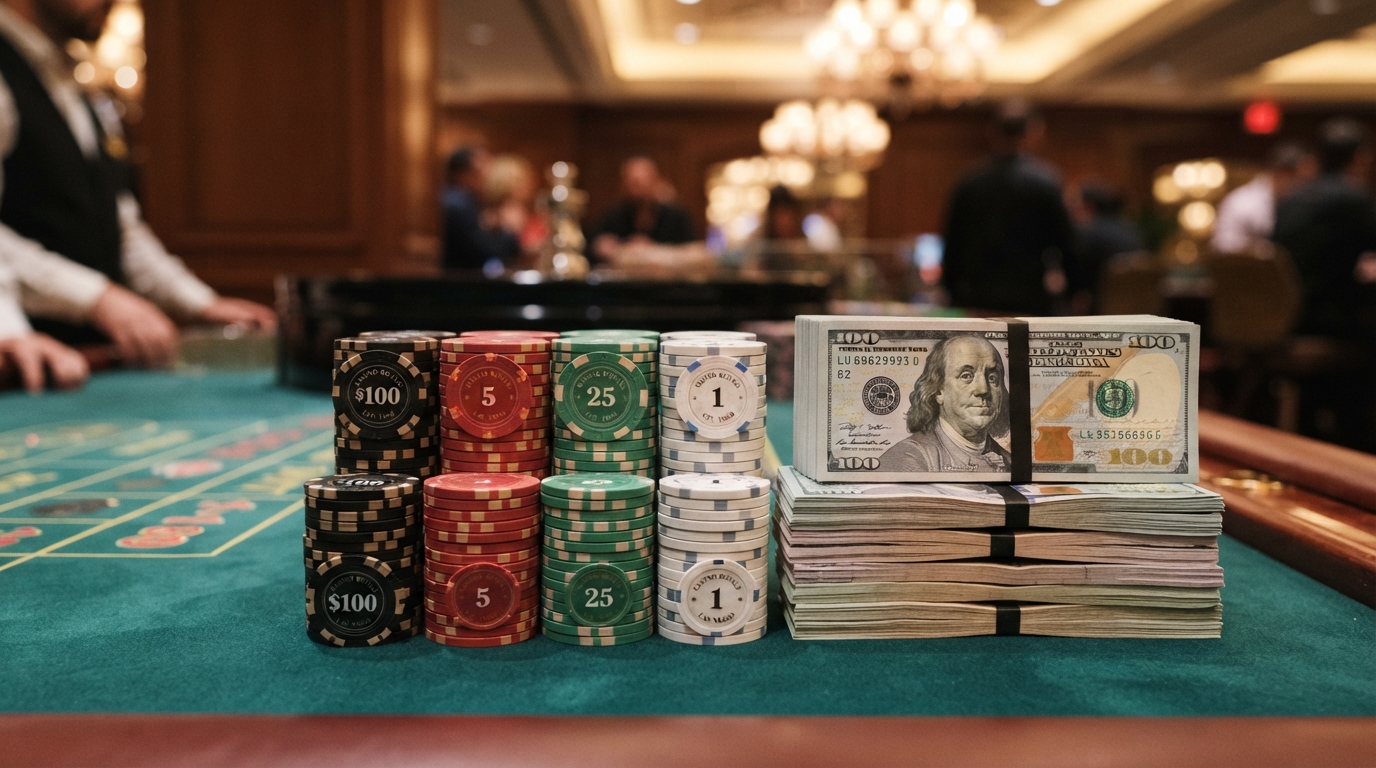
Casino bankroll management is the practice of setting a fixed gambling budget and deciding in advance how much money and time you are willing to spend. It does not change the odds of a casino game or guarantee a winning session. Instead, it helps players establish financial boundaries and avoid spending money intended for essential expenses. WWhile players often dedicate significant intellectual energy to uncovering proprietary roulette systems or memorizing blackjack hit-and-stand charts, the single greatest determinant of longevity, emotional equilibrium, and session success is not luck. It is bankroll preservation.
Understanding the house edge, setting realistic spending limits, avoiding loss-chasing behaviour, and knowing when to stop are important parts of responsible recreational gambling. The objective should be to keep gambling within an affordable entertainment budget rather than treating it as a way to generate income.
Without a concrete staking framework, even a favorable run of positive variance remains vulnerable to sudden reversal. Disciplined bankroll management bridges the gap between chaotic gambling and controlled, recreational gameplay. It replaces impulse with structured thresholds, transforming the gaming experience into an exercise in statistical moderation.
The Philosophy of Bankroll Isolation
The cornerstone of responsible casino strategy begins long before crossing the threshold of a gaming floor or opening a secure Maltese digital portal. It hinges on the categorical separation of money: your bankroll must represent purely discretionary leisure capital.
In financial modeling, capital allocated to high-variance recreational pursuits is deemed already consumed at the moment of allocation. Just as one pays for an opera ticket, a fine dining reservation at the Grand Harbour, or a round of golf without expecting a financial return, casino funds must be classified strictly as entertainment overhead.
Never use money intended for rent, mortgage payments, utilities, food, healthcare, debt repayments, education, savings, or other essential expenses for gambling. Do not use borrowed money or credit to fund gambling. Only consider spending money that remains genuinely disposable after all financial obligations and savings commitments have been met. If losing the entire amount would affect your everyday life, do not use that amount as a gambling budget.
By viewing the bankroll through this psychological lens, the player strips away the toxic anxiety of "needing to make money." This emotional insulation is essential; it prevents panic, fosters deliberate decision-making, and This approach can help players maintain clearer financial boundaries, but it cannot guarantee that gambling will remain harmless or enjoyable. Anyone who finds it difficult to control their spending should consider stopping and seeking appropriate support.
Understanding the mathematical advantage behind casino games is also important when planning a gambling budget. Read our guide to casino house edge across popular games to learn how different game rules and payouts affect the theoretical cost of playing.
The Unit Sizing Model: The 1% to 2% Mandate
Once an isolated bankroll is established, the next imperative is translating that gross capital into discrete tactical units. A base betting unit is the standard wager placed on a single decision or hand. Placing arbitrary wager sizes based on intuition or sudden adrenaline surges is the swiftest route to session depletion.
There is no universally appropriate percentage of a gambling budget that every player should wager on each round. The amount at risk depends on the game, its rules, the size of the wager, and the player's individual financial circumstances. A smaller stake may allow a player to spread their entertainment budget over more rounds, but it does not reduce the underlying house edge or guarantee that the budget will last for a particular length of time. Players should choose affordable limits rather than treating percentage-based staking rules as a guaranteed risk-control method.
For a session bankroll of €1,000, your base wager is €10. This affords 100 bets, providing a robust defensive buffer capable of withstanding prolonged runs of negative statistical variance without exhausting capital.
For a session bankroll of €500, your base wager is €10. Yields 50 bets. Ideal for 90-to-120 minute sessions where double-downs and split pairs can be accommodated without violating table maximum constraints.
Blackjack decisions can sometimes require additional money through doubling down or splitting pairs, depending on the table rules and the player's hand. These actions can increase the amount of money exposed during a round. Players should therefore consider the maximum amount they could be required to wager on a hand when deciding whether a particular table minimum and stake are affordable. No fixed percentage can eliminate the risk of losing a session bankroll. A double down on a 5% unit suddenly exposes 10% of total session assets to a single turn of a card. When two or three consecutive doubling hands fail, the bankroll suffers severe drawdown from which recovery is mathematically improbable within standard session lengths.
Setting Rigid Stop-Loss and Win-Goal Boundaries
Human psychology is naturally vulnerable to cognitive biases inside a casino environment. When winning, players fall prey to the "house money fallacy," erroneously believing that accrued chips belong to the operator rather than themselves, which leads to loose, oversized wagers. When losing, the "sunk cost fallacy" triggers tilt, prompting players to double or triple their stakes to recover deficits rapidly.
To neutralize these psychological traps, you must establish inviolable dual boundaries prior to sitting down at any gaming table:
Before starting a session, decide the maximum amount you can afford to lose without affecting your essential expenses. Treat this as a firm spending limit, not a target to reach. Once the limit is reached, stop gambling. Do not increase it, borrow money, or make additional deposits to recover losses.
Players who choose to set a personal stopping point when they are ahead should decide on it before beginning the session. This can help them avoid making decisions based on excitement or the desire to continue playing. However, a win target does not increase the probability of winning or guarantee that profits will be retained.
Chasing losses is mathematically toxic. When you double bet sizes during a downswing, you do not improve your probability of winning; you merely accelerate your velocity toward total capital ruin. Pre committed boundaries act as an intellectual firewall against impulsive, emotion driven decisions.
Progressive Betting Systems Deconstructed
A ubiquitous error among novice and intermediate players is relying on progressive betting systems most notably the Martingale, Fibonacci, and D'Alembert frameworks. Promoted across internet forums as "guaranteed formulas," mathematical analysis reveals they are mathematically flawed when applied against casino table limits.
In a classic negative progression like the Martingale, a player wagers 1 unit on an even-money proposition (e.g., Red/Black in European roulette). Upon losing, the player doubles the wager: 2 units, then 4, 8, 16, 32, 64, 128, and so forth, until an eventual win recovers all previous losses plus a single original 1-unit profit.
To understand why betting progressions cannot change Roulette probabilities, explore our guide to European Roulette odds and the single-zero advantage.
Consider an initial €10 bet. consider a Martingale strategy starting with a €10 wager on an even-money Roulette bet. After eight consecutive losses, the next required wager would increase to €2,560. The total amount wagered across all nine rounds would be €5,110. A single winning bet at that point would recover the previous losses and produce a net profit of €10, assuming the casino's table limit allows the wager. This example demonstrates how quickly the required stake and potential financial exposure can increase.
Casino table limits vary by venue and game. A progressive betting strategy can become impossible to continue when the next required wager exceeds the table maximum or the player's available budget. Players should never increase their spending or borrow money to continue a betting progression. The moment your required progressive stake exceeds the regulatory table maximum or exhausts your session bankroll, the system collapses, locking in a catastrophic financial loss.
For additional information about gambling products and measures intended to prevent harmful gambling behaviour, see the UK Gambling Commission’s responsible product design guidance.
Changing the size of a wager does not change the underlying probabilities of an independent Roulette spin or remove the house edge. In standard single-zero European Roulette, the house edge is approximately 2.70%, while standard double-zero American Roulette has a house edge of approximately 5.26%. In Blackjack, the probabilities of subsequent cards can depend on which cards have already been dealt and the number of decks remaining. Betting systems do not guarantee profits or eliminate the mathematical risks of casino games.
If you are new to Roulette, our beginner’s guide to European Roulette explains the game’s basic rules, betting options, and common terminology.
Time Boundaries and Session Fatigue
Long gambling sessions can make it harder for some players to maintain concentration and stick to their pre-planned spending limits. Fatigue, emotional reactions, and the desire to recover losses can influence decision-making. The effects vary between individuals, so there is no universally established time after which every player experiences reduced judgement.
Taking regular breaks, checking the time, and stepping away when feeling tired, frustrated, or emotionally affected can help players recognise when it is time to stop. Players should not continue gambling simply because they have already spent a particular amount of time at a table.
Enforce a strict temporal timer on your smartphone or watch. When the alarm chimes, cash out or leave the table, drink water, take a walk along the St. Julian's seafront, and assess your mental state away from the sensory stimuli of the casino floor.
Responsible Gaming Tools in Malta
The Malta Gaming Authority (MGA) enforces world-class standards for consumer protection and player welfare. Within both physical venues across the island and online operators licensed under Maltese jurisdiction, sophisticated protective mechanisms exist to safeguard players.
In Malta, players can request self-barring from land-based gambling premises through the applicable process established by the Malta Gaming Authority. According to the MGA, available self-barring periods are six months, twelve months, or twelve months with automatic renewal. Players can submit a request at the reception area of a licensed gambling operator or through the designated MGA or Responsible Gaming Foundation offices. An active self-barring prevents access to MGA-licensed gambling premises for the duration of the exclusion.
Malta Supportline 179
If gambling is causing distress or becoming difficult to control, support is available through the Foundation for Social Welfare Services (FSWS). Its Supportline 179 provides free, confidential assistance, information, and referrals for people experiencing difficulties, including gambling-related problems. The service operates 24 hours a day, seven days a week.
For confidential assistance, information, and referrals relating to gambling problems, visit the official Foundation for Social Welfare Services Supportline 179 page.
For further information about responsible gambling measures, spending limits, self-exclusion, and player-protection requirements, consult the Malta Gaming Authority’s player protection guidance.
Frequently Asked Questions (FAQ)
How many betting units should I bring to a blackjack session?
There is no universally appropriate number of betting units for a Blackjack session. The amount a player chooses to allocate should depend on their personal financial circumstances, the table minimum, the game rules, and the amount they can comfortably afford to lose. Blackjack can involve additional wagers through doubling and splitting, so players should consider their potential exposure before choosing a stake. A larger bankroll does not guarantee a winning session or prevent losses.
Does increasing bet size after a loss ever reduce overall risk?
No. Increasing a wager after a loss does not guarantee recovery or improve the probability of winning the next independent Roulette spin. In Roulette, previous results do not change the probability of the next spin on a fair wheel. In Blackjack, the probabilities of future cards can depend on the cards already dealt. However, increasing the stake does not automatically create a mathematical advantage. It can expose a larger portion of the remaining gambling budget to loss.
How do I set a realistic win target without leaving the table too early?
There is no mathematically guaranteed win target for casino games. Players who choose to set a stopping point when ahead should decide on it before starting the session and avoid changing it based on excitement or expectations of further wins. For example, someone might decide to end a session after reaching a pre-determined amount of winnings. This is a personal stopping rule, not a strategy that improves the odds of winning.
What is the Kelly Criterion and is it applicable to standard casino games?
The Kelly Criterion is a mathematical approach to determining wager size when a player has a measurable positive expected-value advantage. It is generally not applicable as a profit-generating strategy in ordinary casino games where the player faces a house edge. In standard Roulette and most casino wagers, changing the bet size cannot create a positive mathematical advantage. Certain forms of advantage play may change the expected value under specific conditions, but they require specialised knowledge and do not guarantee profits.
What should I do if I feel an overwhelming urge to chase a session deficit?
If you feel an urge to recover gambling losses by placing additional bets, stop playing immediately. Do not increase your stakes, make additional deposits, or borrow money to continue. Step away from the gambling environment and consider using self-exclusion or other available player-protection tools. If you are finding it difficult to control gambling, contact an appropriate support organisation for confidential assistance. In Malta, you can contact FSWS Supportline 179.
Set an Affordable Gambling Budget
Only use money that you can comfortably afford to lose after meeting all essential expenses. Do not use borrowed money or funds intended for financial obligations.
Set Spending and Time Limits
Decide how much money and time you are willing to spend before starting a session. Stop when either limit is reached and do not increase your budget to recover losses.
Reject Fallacious Systems
Betting progressions such as Martingale and Fibonacci cannot remove the house edge or guarantee profits. Avoid increasing stakes to recover previous losses.
Take Regular Breaks
Monitor your playing time, take breaks, and stop when you feel tired, frustrated, or emotionally affected by wins and losses.