
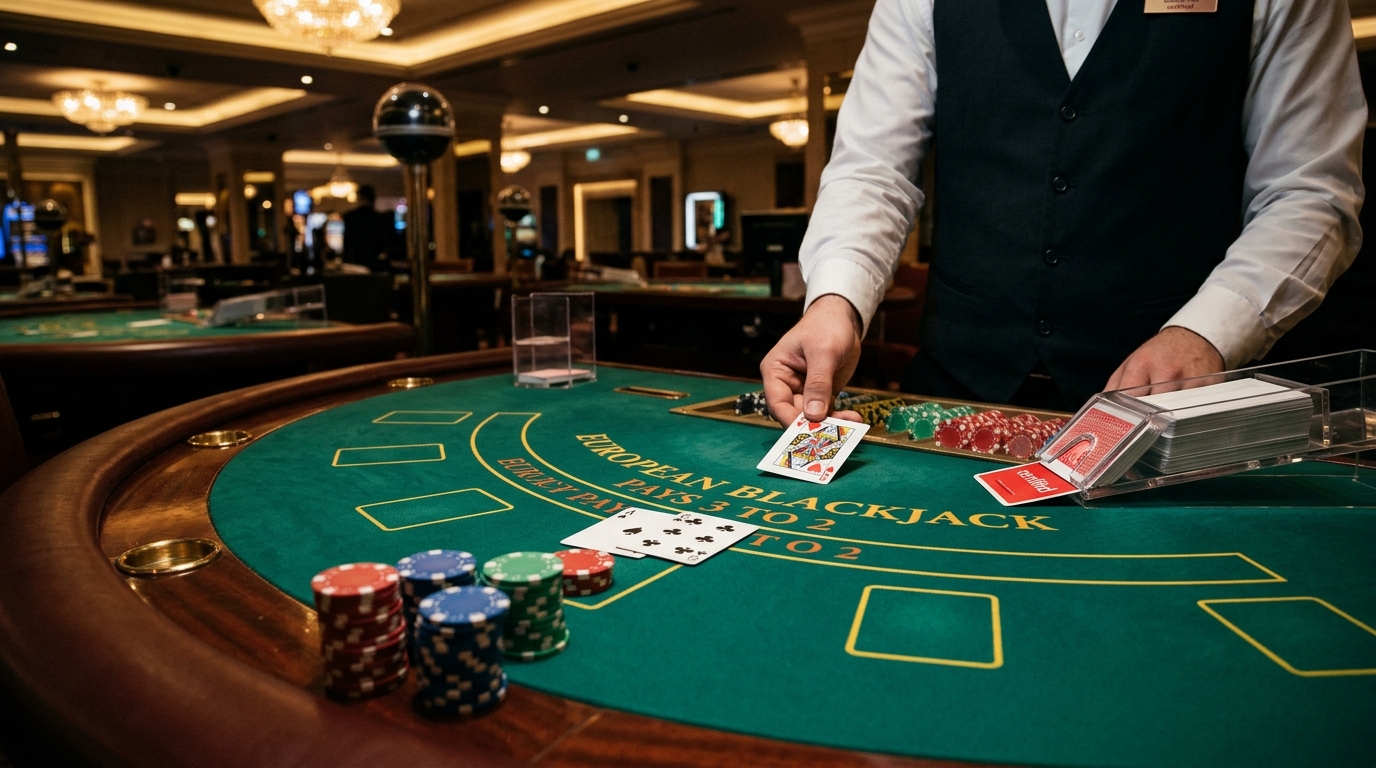
Among the labyrinth of glittering green felt, polished brass rails, and rhythmic shuffles across premier European gaming floors, blackjack retains an unrivaled crown. It is neither a lottery of passive anticipation nor a theatre of untethered intuition. Blackjack is one of the casino table games where mathematical basic strategy can significantly reduce the house advantage. However, the actual house edge depends on the table's rules, including the number of decks, blackjack payouts, dealer soft-17 rules, and doubling restrictions. Even with optimal basic strategy, the casino generally retains a mathematical advantage.
When a player sits at a certified dealing shoe in St. Julian's or Valletta, the cards dealt carry no memory, no favor, and no malice. The dealer follows predetermined rules that depend on the specific blackjack variation. In many games, the dealer must hit on totals of 16 or lower and stand on hard 17 or higher. However, some tables require the dealer to hit on soft 17 (an Ace counted as 11 and a 6), while others require the dealer to stand. Players should always check the table rules before playing.
Understanding the house edge is essential when comparing casino games. Read our guide to understanding the house edge across popular casino games to learn how mathematical advantages affect different games.
Despite the availability of blackjack strategy guides, many beginners make avoidable mistakes, particularly when playing soft hands, deciding when to hit or stand, and responding to the dealer's visible card. Understanding these situations can help players make more informed decisions and avoid unnecessary strategic errors.
The Core Objective: The Myth of 21 and the Reality of Dealer Upcard Vulnerability
Ask an uninitiated player the primary objective of blackjack, and the immediate reflex is almost universal: "To get as close to twenty-one as possible without going over." From a table director’s perspective, that single sentence is the most expensive misconception in gaming history.
Your objective is never to build twenty-one. Your sole, unambiguous mission is to beat the dealer’s hand. This distinction is not pedantic semantic styling; it dictates the exact threshold between profitability and rapid bankroll depletion. A final hand of twelve beats a dealer bust precisely the same as an intricate multi-card twenty-one, paying identical 1:1 true odds.
When you focus on chasing twenty-one, your behavioral psychology gravitates toward hitting modest totals—such as Hard 12, Hard 13, or Hard 14—out of a misplaced anxiety that your point value is weak. In reality, card decks contain an overwhelming density of ten-value cards (tens, jacks, queens, kings account for fully 30.77% of every standard 52-card pack). When you hit hard totals against a dealer displaying a vulnerable upcard (specifically 4, 5, or 6), you assume the dealer’s bust risk onto your own shoulders, busting yourself before the house ever has an opportunity to draw.
The dealer must draw until they reach at least 17. Dealer bust probabilities vary depending on the number of decks and whether the dealer hits or stands on soft 17. Generally, dealer upcards of 4, 5, and 6 are considered vulnerable because the dealer has a higher likelihood of busting than when showing stronger cards such as 7, 8, 9, 10, or an Ace. This is why basic strategy often recommends standing on certain hard totals against these weaker upcards. You do not need a great hand to win against a dealer five or six; you simply need to remain standing alive when the round concludes.
Anatomy of the Hand: Hard Totals, Pairs, and the Crucial Flexibility of Soft Hands
Every starting two-card combination in blackjack categorizes into one of three structural hand profiles: Hard Totals, Split Pairs, and Soft Hands. Understanding how the Ace acts as a mathematical shock absorber is essential to mastering modern basic strategy.
A Hard Hand is any total that contains no Ace, or contains an Ace that must be valued at 1 to prevent exceeding twenty-one. For example, a King and a 6 is a Hard 16. A hand of Ace, 8, and 7 is also a Hard 16, because counting the Ace as eleven results in twenty-six. Hard totals are brittle. Once you hold a Hard 12 or greater, any incoming ten-value card immediately precipitates a bust.
A Soft Hand contains an Ace that can be counted as either 1 or 11 without your point total surpassing twenty-one. A starting combination of Ace and 6 is Soft 17 (or 7). An Ace and 7 is Soft 18 (or 8).
The profound tactical superiority of a soft hand is that a soft hand can never bust on an immediate single hit. If you hold an Ace and 6 (Soft 17) and draw a King, your Ace automatically converts its value to 1, leaving you with a Hard 17. You have suffered no penalty, lost no chips, and preserved your position.
Soft hands provide greater flexibility because the Ace can change its value from 11 to 1 if necessary. This makes hitting a soft hand less risky than hitting a comparable hard total. However, not every soft hand should be doubled. For example, under common multi-deck rules, Soft 18 (Ace-7) is generally doubled against dealer 3 through 6, while Soft 13 through Soft 17 have different recommended actions depending on the dealer's upcard. Players should consult a basic strategy chart that matches the rules of their table.
The Foundational Rules of Basic Strategy Without Memorizing Intimidating Grids
Many players encounter comprehensive color-coded basic strategy charts and abandon them out of intimidation, believing that executing optimal blackjack requires memorizing hundreds of discrete cell intersections. In practice, basic strategy can be simplified into four core operational thresholds:
Players who want to understand the mathematical reasoning behind each decision can explore this detailed blackjack rules and basic strategy reference.
Stand if the dealer shows a 2 through 6 (with the exception of hitting Hard 12 against a dealer 2 or 3). Hit relentlessly if the dealer shows a 7, 8, 9, 10, or Ace. Do not fear busting Hard 16; sitting on a sixteen against a dealer 7 or higher produces a higher long-term loss rate than hitting.
Always double Hard 11 against any dealer upcard from 2 through 10. Always double Hard 10 against dealer 2 through 9. Double Hard 9 against dealer 3 through 6. If the dealer upcard is strong, take a standard single hit rather than doubling.
Soft 18 (Ace and 7) is not a finished hand. Stand against dealer 2, 7, and 8. Double down against dealer 3, 4, 5, and 6. Hit against dealer 9, 10, and Ace. Standing on Soft 18 against a dealer 9 or 10 is a losing play over time.
Always split Aces and 8s under every standard circumstance. Never split Tens or Fives. Splitting tens disassembles an almost certain winning total of 20, while a pair of fives should simply be treated as a Hard 10 and doubled against low upcards.
By observing these broad behavioral clusters, you reduce the casino advantage to its absolute theoretical basement without glancing once at a strategy summary card.
Basic strategy provides the mathematically recommended action for every possible player hand based on the dealer’s visible card. The correct decision depends on the specific blackjack rules, including the number of decks, whether the dealer hits or stands on soft 17, and whether the game uses American hole-card or European No-Hole-Card dealing. The following chart should therefore be matched to the rules of the table being played
European Blackjack vs American Hole Card Dealing: Key Strategic Distinctions
When gaming within regulated European jurisdictions like Malta, players must recognize that table mechanics differ substantially from the Las Vegas strip. The primary operational variance is the European No-Hole-Card (ENHC) rule.
For information about the regulatory classification of casino games in Malta, readers can consult the Malta Gaming Authority’s explanation of authorised game types.
In an American-style game, the dealer receives one card face up and one card face down (the hole card). If the dealer’s upcard is an Ace or a ten-value card, they immediately peek at their hole card via an optical reader mirror. If they hold a natural twenty-one (Blackjack), the round is instantly concluded before players invest additional capital.
European No-Hole-Card (ENHC) blackjack is a variation in which the dealer initially receives only one visible card. Unlike many American blackjack games, the dealer does not check a hidden hole card for blackjack before players complete their actions. As a result, the treatment of additional wagers made through doubling down or splitting can differ. Players should check the individual casino's rules because blackjack procedures and payouts are not identical across all European or Maltese establishments.
To explore the wider evolution of casino gaming in Malta, read our article on Malta’s historic casino landscape and modern gaming environment.
In ENHC games, players may risk losing both their original wager and additional wagers placed through doubling or splitting if the dealer subsequently reveals a natural blackjack. This can affect the mathematically optimal decisions for certain hands, particularly against a dealer's 10 or Ace. Rather than applying American blackjack strategy charts automatically, players should use a strategy chart specifically calculated for the ENHC rules in effect at their table.
For a more detailed understanding of the mathematical differences, consult this European blackjack basic strategy reference, which explains how specific table rules affect player decisions.
The Surrender Option and Why Insurance Is Always a Mathematical Trap
Whenever the dealer displays an Ace, an invitation rings across the table: "Insurance, anyone?" Concurrently, players who hold a natural blackjack are asked if they desire "Even Money."
Let us state the mathematical verdict with absolute clarity: Insurance is a terrible side bet that no disciplined player should ever make.
Insurance is essentially an isolated side wager betting that the dealer’s downcard is a ten-value card, paying 2 to 1 odds. In a six-deck shoe containing 312 cards, there are 96 ten-value cards only if the game uses a non-standard card composition. In a conventional six-deck shoe, there are 144 ten-value cards (10s, Jacks, Queens and Kings), representing approximately 30.77% of the cards. Even if neither of your own cards is a ten, the ratio of non-ten cards to ten-value cards is approximately 2.16 to 1. In a conventional six-deck game, the insurance bet generally carries a house edge of approximately 7.4% before accounting for the cards already removed from play. The exact value can change with the remaining shoe composition. For comparison, proper basic strategy gives the house an edge of less than 0.50%. Accepting insurance increases your exposure to house advantage by more than twelve-fold.
Similarly, taking "Even Money" when you hold a blackjack against a dealer Ace is simply taking insurance on your own winning hand. Over time, allowing your natural blackjack to play out pays an average of $1.04 per dollar risked, compared to accepting a flat $1.00 even-money payout. Refuse both without hesitation.
Conversely, Late Surrender (where permitted) is the most underutilized player-friendly asset in the casino. Late surrender allows a player to give up an eligible hand after the dealer has checked for blackjack, forfeiting half of the original wager. It can be mathematically beneficial in specific situations, such as certain Hard 15 or Hard 16 combinations against strong dealer upcards. However, the best surrender decisions depend on the game's rules and the exact hand composition. Not every casino offers this option. Saving fifty cents on the dollar when facing an eighty-percent probability of losing is brilliant bankroll conservation.
Alongside understanding blackjack strategy, managing your casino bankroll responsibly can help players establish spending limits and avoid unnecessary financial risks.
Casino Table Etiquette, Hand Signals, and Dealer Interaction
In a premier land-based gaming establishment, your vocal words carry zero official weight. Blackjack tables use standardised hand signals to help dealers and casino staff clearly identify player decisions. Although players may communicate verbally with the dealer, physical signals are commonly used to confirm actions such as hitting, standing, doubling down, and splitting. Following the table's procedures helps prevent misunderstandings during gameplay. For your decisions to be legally binding and recognized by floor supervisors, you must utilize standardized physical hand signals:
- To Hit: Gently tap or scratch the green felt behind your cards with one or two fingers.
- To Stand: Wave your flat hand horizontally over your cards, palm facing down, indicating no further action.
- To Double Down: Place an equal stack of chips directly adjacent to your original wager (never stacked on top of it) and extend a single index finger.
- To Split Pairs: Place an equal matching wager next to your original bet and extend two fingers in a distinct “V” shape.
Crucially, in shoe games where cards are dealt face up, never touch your cards with your hands. Attempting to touch face-up cards triggers an instant verbal warning from the dealer and supervisor, as it breaches anti-tampering security protocol. Keep your hands behind the betting circle at all times once the round has commenced.
Frequently Asked Questions (FAQ)
Why should a player always split Aces and 8s regardless of dealer upcard?
A pair of 8s creates a hard total of 16, which is generally a difficult hand to play. Splitting the pair creates two separate hands starting with 8, giving each hand an opportunity to improve. Under many standard blackjack rule sets, splitting 8s is the mathematically preferred decision. However, certain variations, including specific ENHC rule sets, can require adjustments to the standard strategy.
What is the mathematical reasoning behind never taking Insurance?
Insurance pays 2:1 odds on whether the dealer’s hole card is a ten. In a standard deck or shoe, only 4 out of 13 cards (30.77%) are tens, while 9 out of 13 (69.23%) are not. The fair payout for this probability would be 2.25:1. By offering only 2:1, the casino establishes an enormous house edge of roughly 5.9% to 7.4% on the wager, making it a severe negative-expectation proposition.
Why is Soft 17 considered one of the most misplayed hands in blackjack?
Soft 17 (Ace-6) is an important hand because the Ace can change from 11 to 1 if the player draws a card that would otherwise cause a bust. This flexibility makes hitting less risky than hitting a hard 17. Depending on the dealer's upcard and the table rules, basic strategy may recommend hitting or doubling rather than standing. The correct decision should be based on a strategy chart designed for the specific game.
How does European No-Hole-Card (ENHC) change standard basic strategy?
Because the dealer does not peek for blackjack prior to player turns, you risk losing both your original bet and any secondary bets on doubles and splits if the dealer finishes with a natural 21. As a result, basic strategy adjustments require players to hit rather than double 11 against a dealer 10 or Ace, and hit rather than split eights against a dealer 10 or Ace.
Can card counting be applied effectively in standard European casino shoe games?
Card counting is generally less practical in games that use continuous shuffling machines (CSMs), because used cards are continually returned to the machine and reshuffled into the available cards. This makes it difficult to maintain the traditional running count used in shoe games. The effectiveness of card counting also depends on factors such as the number of decks, shuffle procedures, and how deeply cards are dealt before reshuffling.
Never Purchase Insurance or Even Money
The mathematical house edge of 5.8%–7.4% turns insurance into a guaranteed bankroll drain over time.
Exploit Soft Hand Double-Downs
Soft hands cannot bust on a hit. Leverage Soft 13 through Soft 18 when the dealer exposes weak cards (4, 5, or 6).
Respect the Dealer Upcard Threshold
Stop hitting your own stiff totals (12–16) when the dealer shows a 4, 5, or 6. Let the house bust.
Master Formal Physical Signals
Tap the felt for hits, wave horizontally for stands, and never touch face-up cards dealt from a shoe.