
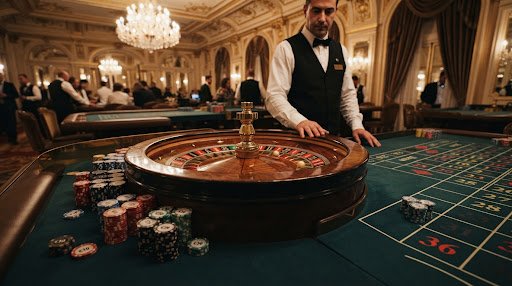
The Geometry of the Single Zero: Wheel Sequence & House Edge
European roulette represents the pristine gold standard of continental gaming elegance. Unlike its transatlantic counterpart, which incorporates an additional double-zero pocket ('00'), the European cylinder is defined entirely by its single green zero ('0') alongside 36 red and black alternating numbers, producing an exact total of 37 pocket partitions. This structural difference fundamentally dictates the mathematical landscape of the game. Where an American double-zero wheel imposes an aggressive house advantage of 5.26%, the single-zero European wheel restricts this baseline edge to a modest 2.70%, radically altering the long-term expected value for discerning participants.
For a broader explanation of how casino advantage and expected value work across different games, read our guide to casino house edge and probability.
The mathematical foundation is derived from standard probability distribution. If you place a straight-up wager on any single number, the payout is 35 to 1. In a mathematically fair game with zero commission, there would be 36 pockets, giving you a 1-in-36 probability of winning. However, the presence of the 37th pocket—the single green zero—shifts the true probability of hitting your exact number to 1 in 37 (approximately 2.7027%). Because a winning straight-up bet pays 35 to 1 while a European roulette wheel has 37 possible outcomes, the theoretical house edge is 1/37, or approximately 2.70%, under standard rules. For every €100 wagered in total over a sufficiently large number of spins, the theoretical average loss is €2.70. This is a long-run statistical expectation, not a prediction of how much an individual player will lose during a session.
For further context on how house edge works in casino gambling, consult the UK Gambling Commission’s explanation of house edge and expected returns
explore The Canonical European Sequence Around the Cylinder
The numbers on a European roulette wheel are arranged in a fixed sequence rather than in numerical order. The layout contains 18 red numbers, 18 black numbers, and one green zero. The wheel's number sequence differs from the betting layout, and red and black pockets do not strictly alternate around the wheel. Moving clockwise beginning directly from the single green zero pocket, the exact sequential order is:
0, 32, 15, 19, 4, 21, 2, 25, 17, 34, 6, 27, 13, 36, 11, 30, 8, 23, 10, 5, 24, 16, 33, 1, 20, 14, 31, 9, 22, 18, 29, 7, 28, 12, 35, 3, 26
The European roulette wheel follows a fixed sequence of numbers that differs from the numerical order printed on the betting layout. Although the wheel's arrangement distributes numbers across different ranges, colours, and parity groups, this arrangement does not guarantee balanced outcomes in any particular section of the wheel. On a fair wheel, each of the 37 pockets has the same probability of being selected on an individual spin, and the sequence of previous results does not reliably predict the next result.
Table Layout & The Racetrack: Inside vs. Outside Bets
The European roulette table cloth, known classically as the baize or layout, is organized into two primary wagering territories: Inside Bets and Outside Bets. Inside bets refer to specific allocations directly upon the grid of 37 numbered compartments, while Outside bets correspond to expansive groupings flanking the exterior boundary of the numbered matrix. In addition, continental tables feature the iconic oval "racetrack", which mirrors the wheel’s physical sequence for rapid sector betting.
Understanding the payout ratios and structural mechanics of Inside wagers is essential for every player entering a licensed casino venue:
The chip is centered entirely inside a single numerical square, including the green zero. Covers 1 of 37 outcomes with a probability of 2.70%.
Placed directly on the dividing line between two adjacent numbers either vertically or horizontally. Covers 2 outcomes with a probability of 5.41%.
Placed on the outer boundary line of a row of three consecutive numbers (such as 7, 8, 9). Covers 3 outcomes with an 8.11% probability.
Positioned at the intersection where four numerical boxes intersect, spanning all four digits. Covers 4 outcomes with a 10.81% probability.
Positioned at the outer T-intersection between two adjacent rows of three numbers, spanning six total numbers. Covers 6 outcomes with a 16.22% probability.
By contrast, Outside Bets offer lower payout multipliers but significantly higher hit frequencies, making them the preferred framework for methodical bankroll stewardship:
To explore the mathematics behind casino payouts and probabilities in more detail, browse our table game mathematics guides.
Wagering on Red or Black, Odd or Even, or Low (1 to 18) and High (19 to 36). Each covers 18 pockets, yielding a probability of 48.65%.
Covering either the first 12 numbers (1 to 12), the second dozen (13 to 24), or the third dozen (25 to 36). Spans 12 pockets with a 32.43% probability.
Positioned at the foot of each 12-number vertical column spanning the entire length of the grid. Spans 12 numbers with an identical 32.43% hit frequency.
For a worked reference to standard roulette bet types and payout ratios, see these published Euro Roulette game rules.
French Call Bets & Sector Wagering
One of the most distinctive aspects of European roulette is the presence of sector wagers, traditionally announced verbally to the croupier and placed on the dedicated racetrack printed alongside the main grid. These combinations allow seasoned players to blanket adjacent sections of the physical wheel mechanism rather than disparate locations on the cloth table.
1. Voisins du Zéro (Neighbours of Zero)
Covering the massive 17-number arc surrounding the single zero from 22 clockwise through to 25. Executed using 9 chips: two chips on the 0-2-3 trio, one chip on the 4-7 split, one chip on the 12-15 split, one chip on the 18-21 split, one chip on the 19-22 split, two chips on the 25-26-28-29 corner, and one chip on the 32-35 split. This bet encompasses roughly 45.9% of the wheel.
2. Tiers du Cylindre (Third of the Wheel)
Covering the 12 numbers directly opposite zero, extending from 27 clockwise to 33. This combination requires 6 chips, with each chip assigned to a separate split: 5-8, 10-11, 13-16, 23-24, 27-30, and 33-36. The Tiers du Cylindre covers 12 wheel numbers using six split bets, each covering two numbers. Since the wheel has 37 pockets, the probability that the ball lands on one of those 12 numbers is 12/37, or approximately 32.43%. Each winning split normally pays 17 to 1, but the overall result of the six-chip combination depends on which split wins and the amount staked on each bet.
3. Orphelins (The Orphans)
Comprising the two remaining slices not included in Voisins or Tiers: specifically numbers 1, 20, 14, 31, 9 on one flank, and 17, 34, 6 on the opposite flank. Orphelins à Cheval requires 5 chips: 1 straight-up chip on number 1, and 4 splits on 6-9, 14-17, 17-20, and 31-34.
4. Jeu Zéro (Zero Game)
A streamlined, concentrated version of Voisins covering only the 7 numbers in the immediate gravitational vicinity of zero: 12, 35, 3, 26, 0, 32, and 15. Requires 4 chips: three splits on 0-3, 12-15, and 32-35, plus one straight-up chip directly on number 26.
In premier European salons, these are called as "announced wagers." The player clearly calls the sector and stakes the corresponding value before the croupier announces closure of the betting cycle. The dealer then arranges the chips directly upon the racetrack baize.
The French Rule Advantages: La Partage & En Prison
Some roulette games offer additional rules, such as La Partage or En Prison, that reduce the house edge on qualifying even-money bets when zero lands. These rules are not guaranteed to be available at every European casino or on every roulette game. Check the published rules before playing. These rules activate exclusively on even money bets (Red/Black, Odd/Even, High/Low) when the ivory ball settles into the green single zero pocket.
Under the La Partage rule, if the ball lands on zero, a losing even-money bet—such as red/black, odd/even, or 1–18/19–36—loses only half of the original stake. The remaining half is returned to the player. This rule reduces the house edge on qualifying even-money bets from approximately 2.70% to 1.35%, assuming standard European roulette payouts and no additional special rules. Availability depends on the specific game or table. This simple partition slices the house advantage on even-money propositions from 2.70% clean in half to an ultra-low 1.35%.
Under the En Prison rule, a qualifying even-money bet is held for the next spin when zero lands rather than being settled immediately as a full loss. Depending on the applicable table rules, a subsequent winning result may return the original stake, while a losing result forfeits it. Under the standard En Prison implementation, the house edge on qualifying even-money bets is approximately 1.35%. Players should check the rules of the specific game because implementation details can vary.
When selecting a European roulette salon in Malta or mainland Europe, seasoned mathematical players will consistently verify with the floor supervisor whether La Partage is active on the table baize, as doing so significantly mitigates the mathematical friction over extended play sessions.
Practical Table Etiquette, Buying In & Croupier Calls
Approaching a physical roulette table in a premier European casino requires adherence to strict ceremonial decorum. Unlike card games, roulette involves dense physical crowding around a communal baize, making orderly chip management, respect for croupier announcements, and spatial awareness essential components of proper play.
1. Value Chips vs. Non-Value "Colour" Chips
When buying into a European roulette table, you do not simply throw cash chips onto the numbers. Instead, you request a specific "colour" from the croupier. You are assigned a unique, unmarked coloured set of chips (e.g., violet, salmon, or ivory) that belongs solely to you at that table, preventing disputes when multiple players stack inside bets on the same coordinates. Before departing, you must cash these back into standard currency value plaques with the croupier.
2. The Crucial Croupier Calls: "Faites vos jeux" & "Rien ne va plus"
The game begins with the croupier announcing "Faites vos jeux" ("Place your bets"). Players may continue placing chips as the croupier spins the wheel and propels the ivory ball in the reverse direction. Once the ball begins to decelerate and drops toward the lower deflector track, the dealer waves their hand across the layout and announces "Rien ne va plus" ("No more bets"). Once the croupier announces “Rien ne va plus” (“No more bets”), betting is closed for that spin. Players should not add, remove, or alter wagers after betting has closed. The precise table procedures and how violations are handled depend on the casino's rules.
3. The Dolly Marker and Payout Sequencing
When the ball comes to rest inside a pocket, the dealer calls the number, colour, and characteristics aloud (e.g., "Vingt-six, noir, pair et passe"), and places a brass or glass marker known as the "Dolly" directly atop the winning number on the cloth. Until the croupier sweeps all losing wagers and pays all winning payouts, no player may touch any chip remaining on the layout. Violating this will immediately invite corrective intervention from the table inspector.
Bankroll Discipline & The Gambler's Fallacy
The greatest pitfall among recreational casino players is the cognitive distortion known as the Gambler's Fallacy—the erroneous belief that past events influence future independent random outcomes. Modern digital displays hanging beside European roulette wheels frequently highlight streaks: showing ten consecutive red landings or tracking "cold" numbers that haven't hit in hundreds of rotations.
For more information about setting spending limits and understanding gambling-related financial risks, see our guide to responsible casino bankroll management.
In mechanical roulette governed by precision manufacturing and strict European standards, each spin is an entirely independent statistical trial. If the ball has landed on Red nine times in succession, the probability of Red landing on the tenth spin remains precisely 18 in 37 (48.65%), identically equivalent to the probability of Black landing (48.65%). The wheel retains no physical memory, no obligation to balance streaks, and no awareness of historical outcomes.
account_balance_wallet Structured Session Protocols for 2026-2027 Play
- Set a fixed spending limit before playing and never gamble with money needed for essentials, bills, or savings.
- Treat the entire amount you bring to a gambling session as money you could lose. No staking formula guarantees a profit or prevents losses.
- Do not increase your bets to recover previous losses. Betting progressions such as Martingale change the size and distribution of potential wins and losses, but they do not remove the house edge.
- Decide in advance how long you will play and take breaks. Stop when you reach your spending or time limit, regardless of whether you are winning or losing.
- Remember that a stop-loss or profit target is a personal limit, not a strategy that changes the mathematical odds of roulette.
For further information about player protection, spending limits, and self-exclusion, consult the Malta Gaming Authority’s player protection guidance.
Frequently Asked Questions on European Roulette
Why is European roulette mathematically superior to American roulette?
European roulette features only a single green zero pocket among 37 total pockets, creating a house advantage of 2.70%. American roulette features both a single zero and a double zero ('00') among 38 total pockets, nearly doubling the casino's advantage to 5.26% on virtually all standard wagers. For standard roulette rules, European roulette has a lower house edge than American double-zero roulette. However, the rules of the particular game—including any available French rules—should be checked before comparing the mathematical odds.
What happens when the ball lands on 0 if I placed an even-money bet?
On standard European tables without French rules, all even-money bets (Red/Black, Odd/Even, High/Low) lose entirely when 0 hits. However, if the table implements La Partage, you receive an immediate 50% refund on your even-money stake. If it implements En Prison, your wager is locked for the subsequent spin; if it hits on that round, your stake is returned in full.
Can I place call bets verbally without touching the racetrack?
Yes, provided the casino permits announced bets. You must announce your wager clearly to the croupier (e.g., "Tier du Cylindre, ten euros") and present the chips onto the baize within reach of the dealer before the croupier announces "Rien ne va plus". The dealer will repeat your wager to validate it and position your chips on the racetrack.
Can any betting system like Martingale or Fibonacci beat the European wheel?
No mathematical progressive system can overcome the inherent house edge of roulette. Because every spin is an independent trial, altering bet sizes between spins does not change the probability distribution of individual pockets. Betting systems merely restructure how variance and risk are distributed across time, often increasing the likelihood of total balance depletion.
How much should I tip the croupier after a winning spin in Europe?
Tipping practices vary by casino and country. There is no universal European rule requiring players to tip after a winning roulette spin. If you wish to tip, check the casino's policy or ask a member of staff whether tips are accepted and how they should be given.
Executive Key Takeaways for Casino Players
Single Zero Edge
The 37-pocket European layout limits the house advantage to 2.70%, vastly outperforming American double-zero variants (5.26%).
La Partage Protection
Seek tables offering French rules, where even-money bets on zero trigger a 50% refund, shrinking the house edge to 1.35%.
Sector Wagering
Racetrack bets such as Voisins du Zéro, Tiers du Cylindre, and Orphelins cover specific groups of wheel numbers using multiple individual wagers. They can help players understand sector betting, but they do not make the next outcome more predictable or remove the house edge.
Strict Table Protocols
Always wait for the Dolly marker to be lifted before touching chips, and respect the "Rien ne va plus" call without hesitation.
Trial Independence
Previous spins have zero statistical influence over subsequent rolls; discard progression-based recovery systems in favor of fixed-unit bankroll gating.