
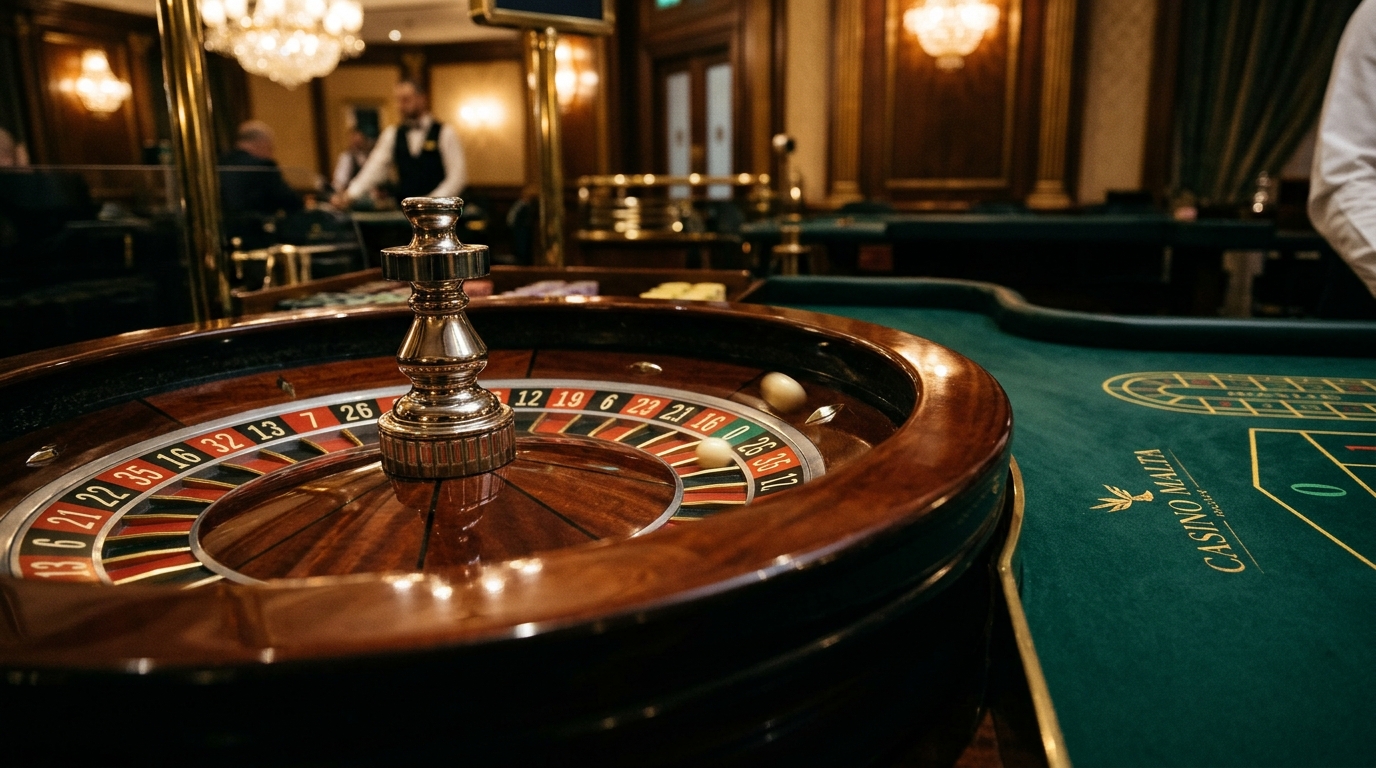
Step onto the polished marble floors of a premier casino overlooking the St. Julian’s waterfront, and your ear is immediately greeted by one of gaming’s most timeless sounds: the crisp, rhythmic click of an ivory-composite ball racing along a solid mahogany rim. To the casual observer, roulette represents pure theatrical serendipity—a hypnotic circle of red, black, and green where fortune is decreed by friction, gravity, and spin velocity. Yet behind this tactile spectacle sits an example of probability applied to a casino game.
For more than two centuries, the roulette wheel has evolved alongside mathematical scrutiny. The most pivotal transformation in this lineage took place in 1843, when French brothers François and Louis Blanc introduced the single-zero wheel in the spa resort town of Bad Homburg. By eliminating the double zero that had populated earlier French and early continental variants, the Blanc brothers slashed the casino’s mathematical withholding power virtually in half.
When Bad Homburg outlawed casino gambling decades later, the Blanc family transported their single-zero standard south to the cliffs of Monte Carlo, forever canonizing what the world now recognizes as European Roulette. Today, within the rigorously supervised gaming establishments of Malta, the European wheel stands as a common roulette variant with a single zero a mathematical framework built on 37 discrete outcomes that fundamentally shifts long-term expected value in favor of the educated patron.
How the probabilities were checked
The probabilities and house-edge calculations in this guide are based on the 37-pocket European roulette wheel and standard published payouts. Calculations assume a fair wheel and independent spins. Special rules, including La Partage and En Prison, are discussed separately because they can change the expected loss on qualifying bets. Readers should consult the published rules for the specific game they are considering.
The Geometry of the Wheel: Number Sequencing and Sector Distribution
Unlike the betting layout on the felt table, where numerals are ordered in sequential integer clusters from 1 to 36 alongside the solitary green zero, the sequence of numbered pockets on a physical European wheel appears completely disordered at first glance. The wheel follows a fixed sequence that differs from the numerical order on the betting layout. Its arrangement determines which numbers are physically adjacent, making it useful for understanding racetrack and neighbour bets. However, the sequence does not guarantee equal numbers of high, low, red, black, odd, or even outcomes within every wheel sector. On a fair wheel, each of the 37 pockets has the same probability of being selected on an individual spin.
Moving clockwise from the green zero pocket, the standard European wheel sequence runs as follows: zero, thirty-two, fifteen, nineteen, four, twenty-one, two, twenty-five, seventeen, thirty-four, six, twenty-seven, thirteen, thirty-six, eleven, thirty, eight, twenty-three, ten, five, twenty-four, sixteen, thirty-three, one, twenty, fourteen, thirty-one, nine, twenty-two, eighteen, twenty-nine, seven, twenty-eight, twelve, thirty-five, three, and twenty-six.
The standard European roulette wheel alternates red and black pockets around the wheel, except where the green zero interrupts the sequence. The numbered pockets follow a fixed order rather than numerical order. This physical arrangement is relevant to wheel-sector bets, but it does not make particular numbers more likely to appear on a fair wheel. Furthermore, the wheel avoids pairing consecutive numbers; across the entire 36 non-zero slots, direct mathematical neighbors are separated by vast spatial leaps across the spindle. High numbers (19 through 36) and low numbers (1 through 18) oscillate in small pairings rather than large continuous blocks, preventing regional clustering of value.
This architectural layout gives rise to the classic continental sector wagers known globally as the French Call Bets. The most celebrated of these is Voisins du Zéro (Neighbors of Zero), which encompasses the seventeen contiguous numbers framing the green zero pocket from 22 all the way around to 25. Across the wheel lies the Tiers du Cylindre (Third of the Wheel), spanning twelve numbers on the opposite arc from 27 to 33. The two remaining flanking sectors are designated as the Orphelins (Orphans), comprising eight numbers that do not belong to either larger sector. Understanding this physical geometry allows seasoned players to conceptualize their wagers not merely as abstract marks on felt, but as physical angular arcs of real estate across a 360-degree rotating cylinder.
Mathematical Foundation: The Exact Mechanics of the 2.70% House Edge
The defining intellectual question of roulette revolves around how the house generates its statistical advantage. The house edge in roulette does not derive from secret mechanical tampering, weighted ivory balls, or esoteric dealer dexterity. Rather, it is baked into the deliberate gap between the true statistical odds of an event occurring and the actual payout ratios awarded when that event occurs.
Consider a straight-up wager on a single number. On a European cylinder, there are exactly 37 distinct, equal-sized pockets: numbers 1 through 36, plus the single green zero. The true mathematical probability of hitting your exact number on any independent spin is exactly 1 in 37, representing a probability of approximately 2.7027%. However, if your number successfully hits, the house pays out at the traditional ratio of 35 to 1.
If the game were mathematically neutral with zero house edge, the payout would be 36 to 1—compensating you for the 36 scenarios where you lose against the 1 scenario where you win. Because the house pays only 35 to 1, it withholds exactly one unit of value over a full theoretical cycle of 37 spins. The expected mathematical outcome of every single chip placed can be stated with absolute precision:
Expected Value = (Probability of Win × Return) - (Probability of Loss × Staked Unit)
Expected Value = (1/37 × 35) - (36/37 × 1) = (35 - 36) / 37 = -1 / 37 ≈ -0.027027 (-2.70%)
To understand how this calculation compares across different casino games, read our guide to casino house edge and expected value.
Over a sufficiently large total amount of wagers, the theoretical house edge of standard European roulette is approximately 2.70%. For example, if a player wagers €100 in total across many bets, the theoretical expected loss is €2.70. This is a long-run mathematical average, not a guarantee that a player will lose exactly €2.70 or any particular amount during an individual session. Now contrast this reality with the American wheel standard prevalent in jurisdictions across the Atlantic.
The American wheel adds an extra pocket: the double zero (00), expanding the cylinder to 38 total pockets while retaining the identical 35-to-1 payout for straight-up wagers. In this 38-pocket universe, the house withholds two units across thirty-eight outcomes (-2/38), resulting in an immediate house edge surge to 5.263%. By simply choosing the single-zero European wheel in Malta over a double-zero variant, a player instantly eliminates almost half of the house advantage without changing a single betting decision.
For a published reference to European roulette’s standard wheel structure, bet types, and payout ratios, consult these European roulette game rules.
The French Rules in European Play: 'La Partage' and 'En Prison' Explained
While the standard 2.70% edge on a single-zero wheel represents exceptional value compared to American alternatives, some European roulette tables and flagship VIP salons in Malta frequently introduce classical French betting rules that improve player odds even further on even money outside wagers. These rules are known universally as La Partage and En Prison.
Under standard roulette mechanics without these special rules, when the ivory ball settles into the green zero, all outside bets including Red/Black, Even/Odd, and High/Low (Manque/Passe) are claimed by the house dealer alongside losing inside wagers. The zero is neither odd nor even, neither high nor low, neither red nor black; it is the universal house marker.
However, on tables operating under the La Partage rule, the outcome shifts dramatically. If you have placed an even-money bet and the ball drops into zero, your wager is not lost entirely. Instead, the stake is split: the house returns exactly 50% of your initial wager directly to you, while claiming the remaining half. Mathematically, halving the loss when zero strikes cuts the expected house withholding on even-money wagers exactly in half, reducing the house edge from 2.70% down to a lean 1.35%.
The sibling alternative, En Prison (literally "In Prison"), operates on a similar mathematical preservation mechanic. When zero appears, your even-money stake is locked onto the table felt by a specialized marker. On the subsequent spin, if your original selection wins (for instance, the ball lands on Red after your Red wager was imprisoned), your entire original wager is returned to you without profit. If the second spin results in Black or another zero, the imprisoned wager is lost to the house. The long-term mathematical advantage of En Prison mirrors La Partage precisely at 1.35%, rendering these tables among the most statistically player-friendly offerings in any licensed casino establishment worldwide.
Betting Taxonomies: Inside vs Outside Wagering Paradigms
A common misconception among beginner players is that specific wagering positions on the felt carry different mathematical house edges. In standard European roulette (excluding tables with La Partage), every single position on the betting grid shares the identical theoretical house edge of 2.70%. The fundamental divergence lies entirely in variance, probability of occurrence, and payout scale.
Wagers are divided structurally into Inside Bets (placed directly on specific numerical combinations) and Outside Bets (placed on larger statistical sectors):
Inside Wagers: A Straight Up wager covers one exact number with a payout of 35:1 and a 2.70% chance of success. A Split (Cheval) straddles two adjacent numbers, returning 17:1 with a 5.41% hit probability. A Street (Transversale Pleine) covers a row of three consecutive numbers, paying 11:1 with an 8.11% probability. A Corner or Square (Carré) covers four intersecting numbers at 8:1 (10.81% probability). Finally, a Six-Line or Double Street (Sixain) spans two adjacent three-number rows, rewarding players at 5:1 with a 16.22% probability.
Outside Wagers: For players seeking lower volatility and steadier session longevity, Outside Bets provide broader coverage. Dozen bets (covering numbers 1-12, 13-24, or 25-36) and Column bets (covering twelve numbers down the vertical spine of the felt) pay 2:1 with a 32.43% mathematical probability. Even-money propositions—Red or Black, Even or Odd, and 1-18 or 19-36—yield a 1:1 return with an 18-in-37 chance of winning, translating to a 48.65% statistical likelihood.
Selecting between inside and outside wagering models is fundamentally an exercise in risk tolerance and bankroll design rather than finding an edge over the house. Inside players accept severe bankroll drawdowns in pursuit of high-multiplier payouts, whereas outside players experience mild fluctuations and extended table endurance.
Explore our table game mathematics guides for more explanations of betting probabilities, payout ratios, and expected value
The Fallacy of Biased Wheels and Hot/Cold Numbers in Modern Mechanical Standards
In nineteenth-century gaming lore, legendary figures like Joseph Jagger famously exploited mechanical imperfections in wooden roulette wheels, tracking thousands of spins to identify warped spindle bearings or loose frets that caused certain numbers to hit far more frequently than pure chance dictated. In historical parlance, this phenomenon was known as a "biased wheel."
Physical roulette wheels can be affected by mechanical imperfections, although the presence and significance of any bias depend on the individual wheel and its condition. It would be inaccurate to assume that every modern wheel is perfectly unbiased or that every casino uses the same monitoring technology.
A fair European roulette wheel has 37 pockets, each with a theoretical probability of 1/37 on an individual spin. Evaluating whether a particular wheel is biased would require reliable observations and appropriate statistical analysis; a short run of unusual results is not enough to establish a bias.
Casino equipment controls, inspection procedures, and monitoring systems depend on the applicable regulations and the equipment used. Any claim about a specific casino's wheel construction, sensors, or testing procedures should be supported by documentation from the manufacturer, operator, or relevant regulator.
Equally pervasive is the psychological belief in "hot" and "cold" numbers displayed on digital casino marquee towers. Because each spin of a roulette wheel is an entirely independent physical event, the ball possesses neither memory nor conscience. If the ball lands on black 17 four times in a row, the probability of black 17 on the fifth spin remains 1/37, or approximately 2.70%, assuming a fair wheel and independent spins. Previous outcomes do not make a particular number “due” to appear, nor do they reliably predict the next result. Relying on marquee history to predict upcoming outcomes is a classic manifestation of the Gambler's Fallacy—the mistaken belief that past independent events influence future random trials.
Pragmatic Session Strategy and Bankroll Discipline on European Felt
Because the European wheel carries an inescapable 2.70% house edge over the long haul, professional approach to the game does not center on "beating" the wheel through magical betting formulas. Rather, it focuses on disciplined session management, volatility optimization, and rigorous bankroll preservation.
One of the most dangerous traps for unseasoned players is the adoption of progressive negative staking systems, with the infamous Martingale strategy being the most prevalent. The Martingale instructs a player to double their wager following every consecutive loss on an even-money bet, operating under the theory that an eventual single win will recover all accumulated losses while yielding a single unit of net profit.
For further guidance on setting spending limits and understanding the risks of casino gambling, read our guide to responsible casino bankroll management.
While this system produces high rates of minor short-term wins, it conceals catastrophic tail risk. Because roulette outcomes are independent, an unbroken sequence of eight or nine consecutive losses is far more common over an evening than human intuition suggests. In a nine-loss sequence, a ten-euro opening stake demands a staggering 5,120-euro wager on the tenth spin simply to reclaim a ten-euro profit. Players inevitably collide with table maximum betting limits or personal bankroll exhaustion, wiping out their entire capital in seconds.
For official information about responsible gambling and player-protection measures, consult the Malta Gaming Authority’s player protection guidance.
Roulette should be treated as entertainment rather than a way to generate income. Anyone who chooses to play should set a spending and time limit in advance, use only money they can afford to lose, and stop when either limit is reached. No staking formula, flat-betting approach, or profit target removes the house edge or guarantees a positive result. Increasing bets to recover losses can increase financial risk, particularly when table limits or available funds are reached. By treating the game as premium entertainment governed by mathematical boundaries, players can fully enjoy the singular ambiance of Malta’s historic gaming salons without falling prey to mathematical illusions.
Frequently Asked Questions (FAQ)
Why does the single zero cut the casino edge almost in half?
In a European wheel, there are 37 total pockets (numbers 1-36 and a single zero). Because winning straight-up bets pay out at 35 to 1, the house retains one pocket's worth of advantage over 37 total outcomes, resulting in 1/37 or 2.70%. An American wheel introduces a second zero (00), expanding the total pockets to 38 while keeping the identical 35-to-1 payout. The house now keeps two pockets out of 38, yielding 2/38 or 5.26%—nearly double the European advantage.
What exactly happens to my bet if the ball lands on green zero?
On standard European tables, all inside wagers that do not directly cover the zero, along with all outside bets (such as Red, Black, Odd, Even), are collected by the house dealer as losing wagers. However, on tables featuring the French "La Partage" rule, players who placed even-money bets receive half of their stake back immediately. On "En Prison" tables, even-money stakes are held over for one spin to determine if they are returned or forfeit.
Is European roulette always better to play than American roulette?
Under standard roulette rules and identical payouts, European roulette has a lower house edge than American double-zero roulette: approximately 2.70% compared with 5.26%. That makes European roulette mathematically more favourable to the player under those conditions. However, individual games can have different rules or features, so check the published rules before comparing them. A lower house edge does not guarantee that an individual player will win.
Can modern European wheels have physical mechanical biases?
In modern regulated casinos, physical wheel bias has been virtually eliminated. Cylinders are manufactured using computerized CNC milling processes with micron-level tolerances. Integrated optical monitoring systems continuously track every spin to detect and report even minute deviations from true random distribution before human players could ever identify them.
What is the difference between French Roulette and European Roulette?
European and French roulette commonly use the same single-zero wheel with 37 pockets. French roulette is associated with traditional French betting terminology and rules such as La Partage or En Prison, which can reduce the house edge on qualifying even-money bets to approximately 1.35% when the applicable rule is used. These rules are not guaranteed to be available at every table, so players should check the specific game's published rules.
Key Takeaways for Roulette Players
Single-Zero Wheel
Standard European roulette has 37 pockets, numbered 0–36. Its theoretical house edge is approximately 2.70% under standard payouts.
European vs. American Roulette
Standard European roulette has a lower house edge than standard American double-zero roulette: approximately 2.70% versus 5.26%.
French Rules
La Partage and En Prison can reduce the house edge on qualifying even-money bets to approximately 1.35%, depending on the rules of the game.
Randomness and Responsible Play
Previous spins do not reliably predict future outcomes on a fair wheel. Set spending and time limits, avoid chasing losses, and remember that no betting system guarantees a profit.