
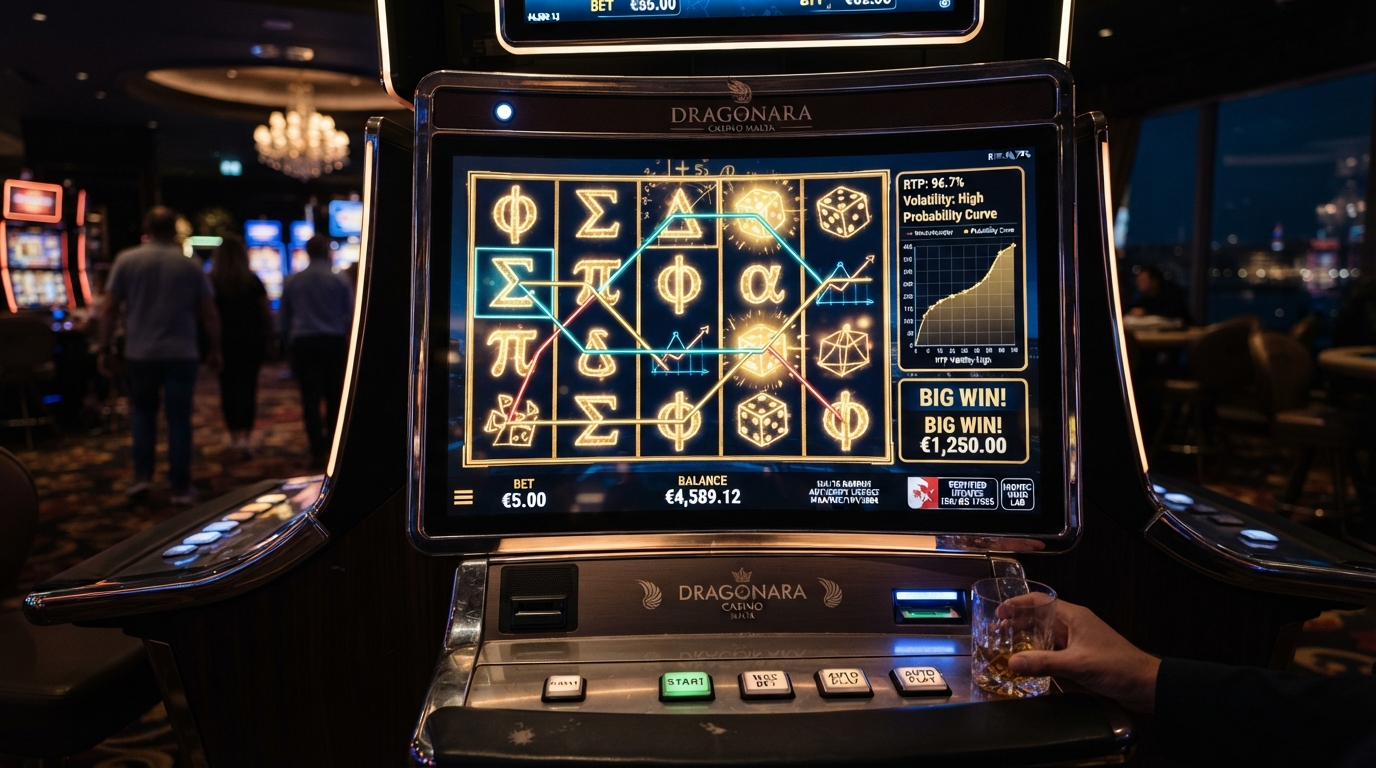
"Randomness in regulated gaming machines is neither mysterious fate nor mechanical inertia. It is an unceasing, deterministic mathematical calculation cycling millions of states per second, completely indifferent to player perception, bankroll size, or past outcomes."
If you are new to casino gaming, explore our Casino Basics guides for beginner-friendly explanations of game rules, terminology and fundamental concepts.
The Core Mechanism: What Is a Pseudo-Random Number Generator (PRNG)?
At the epicenter of modern Electronic Gaming Machines (EGMs) in premier Maltese land-based establishments and European-licensed digital video slots lies the Pseudo-Random Number Generator (PRNG). Contrary to widespread player belief, a slot machine contains no physical memory reels or mechanical brakes that halt on chosen symbols. Rather, the reels, graphical interfaces, and celebratory audio cues are merely delayed cinematic renderings of a mathematical result that was determined the precise millisecond the player initiated the wager.
The term "pseudo-random" describes numbers generated by a mathematical algorithm rather than directly by a physical random event. A software-based PRNG produces a sequence of values from an internal state and an initialisation process commonly called a seed. When properly designed and implemented, the output should be statistically suitable for the game, difficult to predict and resistant to unauthorised manipulation. The exact algorithm and security design depend on the game manufacturer and the approved gaming system; there is no single PRNG algorithm used by every slot machine.
A seed or initial state is used to start a pseudo-random number sequence. The method used to generate and manage that state depends on the system's technical design. It should be implemented so that the resulting sequence cannot be feasibly predicted or reproduced by unauthorised parties.
How a Slot Machine Determines the Result
In a typical electronic video slot, a random number generator supplies values that the game software uses to determine the result according to the game's programmed rules and paytable.
When a player starts a spin, the game uses the appropriate random output to determine the outcome. The symbols shown on the screen are then presented according to the game's design. The visual reel animation should not be confused with a physical mechanism that independently decides the result.
The exact timing, random-number generation process and mapping of random values to game outcomes depend on the specific gaming system. A properly implemented RNG must produce outcomes that meet the applicable technical requirements for randomness, unpredictability and fair distribution. It is not accurate to assume that every slot machine uses an identical algorithm or operates at a particular processing speed.
For a useful example of published technical requirements for gaming RNGs, readers can consult the UK Gambling Commission’s guidance on random number generation.
Dispelling the Hot and Cold Machine Fallacy
Among both casual visitors to St. Julian's gaming floors and regular video slot players, no misconception is more persistent than the doctrine of "hot" and "cold" machines. Gamblers often observe a terminal that has absorbed substantial bankrolls without triggering an expansive bonus sequence and conclude that it is "due" for an imminent release.
From a mathematical perspective, this belief represents a classic instantiation of the Gambler's Fallacy—the mistaken conviction that past statistical outcomes influence future probabilities in independent trials.
Independent Statistical Trials: Mathematical Proof
Let trial \( S_n \) denote the outcome of spin \( n \). Under certified RNG architectures:
P(Win on \( S_n \) | Loss on \( S_{n-1} \cap S_{n-2} \cap \dots \cap S_{n-k} \)) = P(Win on \( S_n \))
For a properly implemented slot game with fixed rules and a fixed paytable, previous wins and losses do not make a particular outcome "due". The RNG is designed to produce unpredictable results rather than compensate for a player's previous losses or wins. This means that a long losing streak does not guarantee that a jackpot or bonus round is approaching. The exact operation of an RNG depends on its implementation, but players should not assume that previous outcomes provide a reliable method for predicting the next spin.
A sequence of consecutive wins or losses can occur naturally in a random game. Such a sequence does not establish that a machine has become more or less likely to pay out on its next spin. Over short sample sizes, human perception detects artificial patterns where only stochastic noise exists.
Theoretical Return to Player (RTP) vs Realized Volatility
A slot game's Return to Player (RTP) is its theoretical percentage payout over a very large number of plays under the game's stated rules. For example, a game with a theoretical RTP of 96% is designed to return an average of €96 for every €100 wagered over the long run, while retaining a theoretical house advantage of 4%. Actual results for individual players can be substantially higher or lower. RTP values vary between games and, in some cases, between different versions of the same game. Players should check the information provided for the specific game rather than assume that all regulated slots use the same RTP range. A persistent customer grievance arises when a player deposits €100 into a machine rated at 96.00% RTP and walks away empty-handed fifteen minutes later.
RTP is closely related to the house advantage built into casino games. Read our guide to understanding casino house edge across popular games to learn how theoretical returns and expected losses differ between games.
To comprehend this discrepancy, one must understand the mathematical distinction between asymptotic theoretical return and localized session volatility:
Theoretical RTP
Theoretical RTP is a long-run statistical measure, not a promise about the return from a particular session. A game with a 96% RTP does not guarantee that a player will receive €96 back after wagering €100. Short sessions can produce results far above or below the theoretical percentage because payouts are distributed unevenly across individual spins. The extent of these fluctuations depends on the game's paytable, hit frequency and volatility. A larger number of plays can provide a better indication of the theoretical average, but it does not guarantee that an individual player will receive the published RTP.
Mathematical Volatility
Slot volatility describes how widely a game's payouts can fluctuate around its theoretical average. Two games can have the same RTP but very different payout patterns. A lower-volatility game may provide smaller wins more frequently, while a higher-volatility game may produce longer periods without significant payouts followed by less frequent but potentially larger wins. Volatility is related to statistical variance, but the terms are not always interchangeable in how slot games are described to players.
Common Slot Volatility Profiles
Low-volatility games generally distribute smaller payouts more frequently. Individual wins may be modest, and the game may experience fewer dramatic swings. However, frequent payouts do not necessarily mean that a player will make a profit.
Medium-volatility games aim to balance the frequency and size of payouts. Players may experience a mixture of smaller wins and less frequent larger payouts, depending on the game's paytable and bonus features.
High-volatility games generally have more pronounced fluctuations. They may produce longer sequences without significant wins, while some payouts can be considerably larger. These games can also result in rapid losses, particularly when players use larger wagers.
Volatility labels are not fully standardised across all game developers. The actual payout distribution, hit frequency, maximum win and bonus mechanics should be checked in the information provided for the individual game.
Hit Frequency vs Payout Magnitude
A common point of confusion among recreational players is conflating Hit Frequency with mathematical profitability. Hit frequency merely expresses the statistical probability that any given spin will generate any non-zero cash credit return, calculated as:
Hit frequency is the percentage of game rounds or spins that produce a payout, according to the game's stated definition. For example, a slot with a 30% hit frequency may produce a payout on approximately 30 out of every 100 spins over a sufficiently large sample. This does not mean that every payout is greater than the amount wagered. A spin can return some credits while still leaving the player with a net loss
Consider a player wagering €2.00 across 25 paylines. The reels stop, celebratory musical chimes trigger, lights flash, and the machine announces a "WINNER!" of €0.80. The PRNG registers this as an official hit. The player's cognitive processing is stimulated by rewarding sensory cues. Yet from an objective financial balance sheet perspective, the player has incurred an instantaneous net deficit of €1.20 (-60% on that spin).
Sophisticated players evaluate games not merely by raw hit frequency, but by the distribution curve: what percentage of hits are true net-positive returns versus compensatory micro-returns.
Research has also examined how losses disguised as wins can influence gambling behaviour. A field study published in the Journal of Gambling Studies investigated how these outcomes were associated with subsequent betting behaviour among slot machine players. Read the research on losses disguised as wins for further information.
Regulatory Compliance & Certification in Malta
Gaming activities in Malta are subject to the applicable requirements of the Malta Gaming Authority (MGA). These requirements include technical and compliance obligations intended to support the integrity of regulated gaming systems. The specific requirements depend on the type of gaming activity, the equipment involved and the applicable regulatory framework.
Gaming equipment and software may be subject to technical testing and certification requirements under the applicable regulatory framework. Testing arrangements and the required approvals depend on the type of gaming system and the relevant licence conditions. Readers should consult the MGA's official regulations and technical documentation for the requirements applicable to a particular gaming activity.
Technical assessments of gaming systems may include:
- Randomness testing: Evaluating whether random-number outputs meet applicable statistical and unpredictability requirements.
- Game mathematics and payout testing: Checking that the game operates according to its approved rules, mathematical design and stated paytable.
- Software and system integrity: Assessing relevant software controls and safeguards against unauthorised changes.
- Regulatory compliance: Confirming that the system meets the technical and operational requirements applicable to the relevant licence and jurisdiction.
The exact testing procedures depend on the product and the regulator's requirements. These examples should not be interpreted as a complete list of mandatory tests for every slot machine.
For further information about the regulatory framework governing gaming devices in Malta, readers can consult the relevant Gaming Devices Regulations.
Pragmatic Player Guidelines: Volatility Management
While mathematical house edge cannot be overcome through betting progression strategies like Martingale or D'Alembert, understanding volatility equips players with rational tools to protect their entertainment budget and align their experience with personal risk tolerances.
Setting a realistic gambling budget is important regardless of a slot game’s volatility. Our guide to casino bankroll management and smart session play explains how to set spending limits and avoid chasing losses.
Unit Bet Sizing Rule of Thumb
There is no universal bankroll size that guarantees a player can withstand the fluctuations of a high-volatility slot. A larger number of small wagers may spread spending across more spins, but it does not change the game's RTP or guarantee that a bonus round will occur. Players should decide in advance how much money they can afford to spend, use small wagers that fit within that budget and stop when their spending limit is reached.
Pre-Determined Stop-Loss & Profit Milestones
Before playing, decide how much money and time you are willing to spend. Stop when you reach your predetermined spending limit, whether you are ahead or behind. A profit target may be used as a personal reason to end a session, but reaching a particular win amount does not change the game's mathematical advantage or guarantee that future winnings will be preserved. Never increase your wagers to recover previous losses.
Acknowledge Sunk Cost Bias
Do not increase your wager because you believe a slot machine is due for a payout after a losing streak. Previous results do not provide a reliable way to predict the next spin. With fixed game rules and a fixed paytable, the theoretical outcome probabilities do not become more favourable simply because you have lost money. Increasing your stake can increase the amount you lose without improving your chance of winning.
Frequently Asked Questions (FAQ)
Direct answers to the most common technical questions concerning slot mechanics and Maltese regulatory oversight.
Can casino staff manipulate slot payout rates remotely?
Gaming operators and their staff must comply with the applicable regulatory and technical requirements. A properly regulated game should operate according to its approved rules and payout configuration, with controls designed to protect against unauthorised changes. The exact technical safeguards and approval procedures depend on the gaming system and applicable regulatory requirements. Players should consult the relevant regulator's published information rather than assume that all machines use the same hardware or software controls.
Does playing at certain times or days increase payout odds?
For a properly implemented slot game operating with fixed rules and a fixed paytable, there is no reliable reason to expect better odds simply because you play at a particular time of day or on a particular day of the week. A quiet casino floor or a busy weekend does not make a slot machine due to pay out. Previous results and the time of play should not be used as a reliable method for predicting the next result.
What is the mathematical difference between variance and volatility?
Variance is a statistical measure of how widely outcomes are spread around their expected value. Standard deviation is the square root of variance and is expressed in the same units as the measured outcomes. In slot gaming, volatility is a broader term commonly used to describe how frequently and how substantially payouts fluctuate. Although the concepts are related, volatility is not always a precise synonym for statistical variance.
How does bonus round frequency affect base game RTP?
A slot game's total theoretical RTP can include returns from both its base game and bonus features. The proportion contributed by each part depends on the game's mathematical design. For example, a bonus feature may contribute a significant share of the total theoretical return, but players cannot assume that the bonus will occur within a particular number of spins. The actual breakdown should be taken from the game's published mathematical information, where available.
Are online slots more volatile than land-based terminals?
Online slots are not automatically more volatile than land-based slot machines. Volatility depends on the individual game's mathematical design, payout distribution, hit frequency and bonus features, rather than simply whether it is played online or on a physical machine. Both online and land-based games can offer different volatility profiles and maximum payout levels. Players should check the published information for the specific game.
Understand Random Number Generation
Electronic slot games use random-number generation to determine game outcomes according to their programmed rules. Previous wins or losses do not make a particular result due.
Compare RTP and Volatility
RTP describes a game's theoretical long-term payout percentage, while volatility describes how widely its payouts can fluctuate. Two games with the same RTP can have very different payout patterns.
Understand Hit Frequency
A high hit frequency does not necessarily mean frequent profits. Some payouts may be smaller than the amount wagered, resulting in a net loss.
Set Responsible Spending Limits
Slot machines are games of chance. Decide how much money and time you can afford to spend before playing, avoid chasing losses and never treat gambling as a source of income.