
New to casino terminology? Explore our Casino Basics guides for straightforward explanations of common casino games, rules, and terminology.
The Mathematical Definition of House Edge
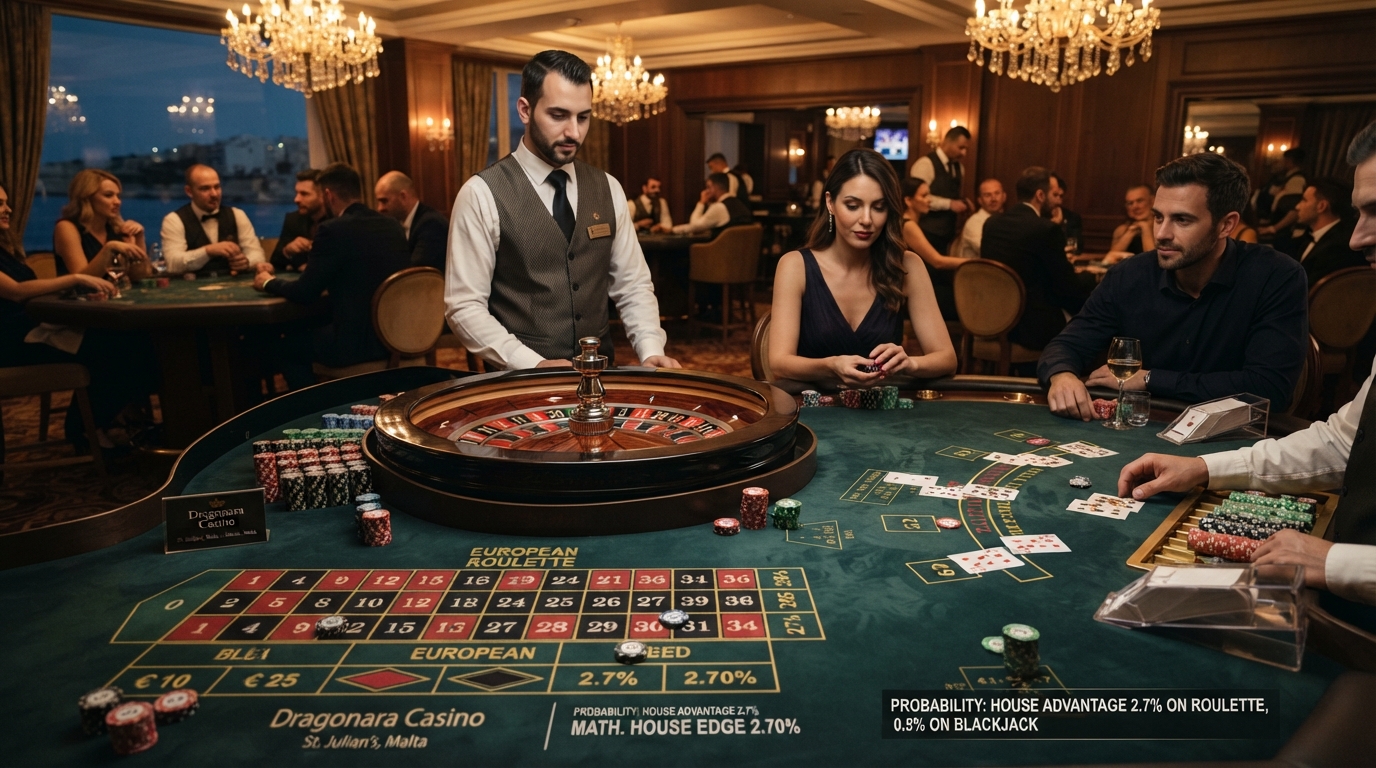
Most casino games are designed with a mathematical house advantage, meaning that the casino has a statistical edge over players over the long run. This advantage is built into the game's rules, payouts, or probabilities. However, the exact house edge varies by game, wager type, and table rules. This foundational metric is known as the casino house edge. House edge represents the casino's theoretical mathematical advantage over players, expressed as a percentage of the amount wagered. It is calculated using the probabilities of all possible game outcomes and their corresponding payouts.
In practical terms, a house edge of 2% means that a casino theoretically retains an average of €2 for every €100 wagered over a sufficiently large number of bets. This does not represent a guaranteed loss for an individual player or a prediction of the outcome of any particular session.
The actual house edge depends on the game's rules, payout structure, betting options and, in some games, the decisions made by the player.
In formal mathematical parlance, house advantage represents the negative Expected Value (EV) of the player's wager expressed as a normalized percentage of the original capital staked. Expected Value quantifies what an individual bettor can expect to win or lose on average per hand, spin, or throw over an infinitely large sample size of trials.
Expected Value (EV) is calculated by multiplying the net result of each possible outcome by its probability, then adding those values together.
A negative EV means that the player is expected to lose money on average over a large number of wagers. A positive EV means the player is expected to gain money on average, before considering other costs or conditions.
The house edge is calculated from the complete set of possible outcomes, their probabilities, and the net payouts. For a standard casino wager, a positive house edge corresponds to a negative expected value for the player.
The Law of Large Numbers explains why actual results tend to move closer to their theoretical averages as the number of independent trials increases. However, it does not guarantee that a casino will achieve its expected result over a particular session or even a specific short period. Individual players can experience significant wins or losses because of short-term variance.
Blackjack House Advantage Explained
Blackjack can offer a relatively low house edge compared with many other casino games. Under favourable rules, a player using mathematically correct Basic Strategy may face a house edge of around 0.5%. However, this figure is not universal. It depends on factors such as the number of decks, whether the dealer hits or stands on soft 17, blackjack payouts, doubling and splitting rules, surrender availability, and other table conditions. Players should check the specific rules before comparing tables.
One important source of the house advantage in Blackjack is that players act before the dealer. If a player busts by exceeding 21, the wager is normally lost immediately, even if the dealer later busts as well. This rule contributes to the house edge, but the overall advantage also depends on the game's payout structure, dealer rules, and player decisions.
For a more detailed breakdown of Blackjack probabilities, house-edge calculations, and rule variations, consult the Wizard of Odds Blackjack resources.
The Devastating Impact of Table Rule Variations
Subtle alterations to standard house procedures radically shift the house edge. Astute players must scrutinize the table felt before wagering:
Replacing the traditional 3:2 payout on a natural blackjack with a 6:5 payout significantly increases the house edge. For example, on a €20 wager, a 3:2 payout earns €30 in net winnings, while a 6:5 payout earns €24. The 6:5 rule can add approximately 1.39 percentage points to the house edge under commonly analysed rules. The final house edge depends on the table's other rules and the strategy used.
Tables stipulating that the dealer must hit Ace-6 (Soft 17) rather than stand provide the house additional opportunities to improve marginal totals, increasing overall player loss rates. These figures are illustrative estimates rather than universal values. The actual effect depends on the deck count, blackjack payout, doubling and splitting rules, and other conditions at the table.
Under standard European procedures common across Mediterranean venues, the dealer takes their second card only after all players conclude play. If a player doubles or splits against a dealer Ace or 10 and the dealer hits a natural, the player forfeits all accrued investments rather than preserving splits. These figures are illustrative estimates rather than universal values. The actual effect depends on the deck count, blackjack payout, doubling and splitting rules, and other conditions at the table.
To understand how betting decisions and table rules affect the cost of playing, explore our guide to casino bankroll management and responsible session planning.
Roulette Odds Comparison: European vs. American Architecture
Roulette represents the purest illustration of house advantage engineered directly through green zero segments. A European roulette cylinder contains 37 physical pockets: numbered 1 through 36 (split equally between red and black) plus a single green zero (0). A winning straight-up wager pays 35 to 1. If you wager €10 on single number 17, and the roulette ball settles into pocket 17, the casino awards you €350 along with returning your original €10 stake.
The true mathematical probability of hitting that number is 1 in 37 (2.7027%). If payouts reflected true fair odds without a house advantage, the casino would pay 36 to 1. By paying 35 to 1 on an event that occurs once every 37 trials, the operator retains an expected:
House Edge (European) = (37 − 36) / 37 = 1 / 37 ≈ 2.70%
By contrast, American roulette incorporates both a single green zero (0) and a double green zero (00), expanding the cylinder to 38 pockets. Crucially, the payout for winning straight-up bets remains identical at 35 to 1. The probability of success drops from 1/37 to 1/38 (2.6316%). The resulting mathematical discrepancy widens significantly:
House Edge (American) = (38 − 36) / 38 = 2 / 38 ≈ 5.26%
The presence of that second green pocket almost exactly doubles the mathematical extraction rate. In sophisticated Mediterranean venues operating French roulette provisions, the La Partage rule further protects players. Under La Partage, whenever the ball lands in the green zero on an even-money proposition (Red/Black, Odd/Even, High/Low), half of the bet is refunded immediately to the player. Under the La Partage rule, when the ball lands on zero, half of an even-money wager (such as Red/Black, Odd/Even, or High/Low) is returned to the player. On a standard single-zero European wheel, this reduces the house edge on those specific bets from approximately 2.70% to 1.35%. The rule does not apply to every roulette wager, so players should check the table rules.
For a closer look at European Roulette probabilities, payouts, and the single-zero advantage, read our guide to European Roulette odds and rules.
For an additional reference on European Roulette rules and payouts, consult the official European Roulette game rules published by Monte-Carlo SBM.
Baccarat Payout Probabilities & The Tie Bet Trap
Baccarat, particularly the Punto Banco version, is a game in which the drawing rules are largely fixed. Players generally choose between betting on the Banker, Player, or Tie outcome. Under standard eight-deck rules with a 5% commission on winning Banker bets, the Banker and Player wagers have relatively low house edges. However, the exact figures can change when the table uses different payout or commission rules.
There are three core betting spots on a standard baccarat layout:
In a standard eight-deck Punto Banco game with a 5% commission on winning Banker bets, the Banker wager has a house edge of approximately 1.06%. Banker wins about 45.86% of all hands. Ties normally result in the Banker and Player wagers being returned, so the Banker win percentage should not be confused with its probability of winning among decisive (non-tied) hands.
Under the same standard eight-deck rules, the Player wager has a house edge of approximately 1.24%. The Player hand wins about 44.62% of all hands, while ties normally return the original Player wager. These percentages are specific to the standard game and should not automatically be applied to every Baccarat variation.
A Tie wager commonly pays 8:1, although some tables offer 9:1. In a standard eight-deck game, a tie occurs approximately 9.52% of the time. At an 8:1 payout, the Tie bet has a house edge of approximately 14.36%. If the payout is 9:1, the house edge is substantially lower, at approximately 4.84%. Players should always check the payout displayed on the table before placing this wager.
Craps House Edge: Pass Line, Odds Bets and Proposition Bets
Craps occupies a unique position in probability analysis because it contains simultaneously the lowest and highest house edges under one layout. Under standard Craps rules, the Pass Line bet has a house edge of approximately 1.41%, while the Don't Pass bet has a slightly lower house edge of approximately 1.36%. The Don't Pass wager generally wins when the shooter rolls 2 or 3, loses on 7 or 11, and pushes on 12. Actual rules should always be checked because variations can affect the odds.
Once a point is established, players may be allowed to place an additional Odds wager behind their Pass Line or Don't Pass bet. This wager pays true mathematical odds and carries a 0.00% house edge on its own. However, it must be placed alongside an eligible line bet, and casinos set limits on how much Odds a player can take. Taking additional Odds can reduce the combined house edge on the total amount wagered, but it does not remove the house edge on the original line bet.
Conversely, the center of the craps layout contains proposition wagers designed to exploit emotional momentum. The "Any 7" wager pays 4 to 1 on an outcome carrying 5 to 1 true odds, delivering a staggering 16.67% house edge. Similarly, "Hardways" (Hard 4, Hard 10) carry edges hovering at 11.11%. The contrast between the disciplined perimeter line wagers and the center-table propositions reflects the fundamental divide between informed mathematical play and speculative dissipation.
Expected Loss Calculation in Real Play
Theoretical percentages can feel detached from practical casino visits. To translate house edge into tangible budgeting units for responsible entertainment, players utilize the standard Expected Loss Equation:
Total Amount Wagered = Number of Bets × Average Stake per Bet
For example, if a player makes 100 bets of €10 each, the total amount wagered is €1,000. At a 2% house edge, the theoretical expected loss is €20 over a large number of comparable bets. This is an average mathematical expectation, not a prediction of the result of an individual session.
Consider two hypothetical examples to understand how house edge affects the expected cost of playing different casino games. These calculations are illustrations only and do not represent actual player results or verified table conditions at a specific casino.
- • Game: 6-deck European Blackjack (Basic Strategy)
- • Pace: 60 hands per hour (Full table)
- • Total Hands (2 hrs): 120 hands
- • Average Bet: €25 per hand (€3,000 total action)
- • House Edge: 0.50%
- Expected Session Cost: €3,000 × 0.005 = €15.00
- • Game: Double-Zero American Roulette
- • Pace: 40 spins per hour
- • Total Spins (2 hrs): 80 spins
- • Average Bet: €25 per spin (€2,000 total action)
- • House Edge: 5.26%
- Expected Session Cost: €2,000 × 0.0526 = €105.20
These examples demonstrate how the house edge affects the theoretical cost of wagering. Player A has a higher total wagering volume, but the assumed lower house edge produces a lower expected loss. Actual results can differ substantially because short-term wins and losses are affected by chance and variance. A lower house edge does not guarantee a winning session.
Understanding the house edge is only one part of responsible gambling. Players should also set spending limits and seek support if gambling stops being an enjoyable activity. Read the Malta Gaming Authority’s player protection information for further guidance.
Frequently Asked Questions
Can a player ever overcome the casino house edge in the long term?
In games where the rules give the casino a positive house edge, a player using ordinary betting strategies should expect to lose money over a sufficiently large number of wagers. However, a positive house edge does not mean a player cannot win individual sessions. Certain forms of advantage play, such as skilled card counting in some Blackjack games, may create a positive expected value under specific conditions. Whether a particular technique is permitted depends on the casino's rules and the applicable laws. No betting system can guarantee consistent profits.
Which casino game mathematically offers the lowest house advantage?
Among core table offerings, Blackjack with player-favorable rules (3:2 payout, surrender, double on any cards) operated under strict Basic Strategy offers an edge as low as ~0.40% to 0.50%. The Odds wager in Craps has a 0.00% house edge on the additional Odds amount itself. However, it must be placed alongside an eligible Pass Line or Don't Pass wager, which still carries a house edge.
Why do casinos offer games with a house edge under 1%?
First, volume. A high-turnover game with a small edge generates reliable, massive macroscopic revenue across millions of hands. Second, human error: while theoretical Blackjack edge is ~0.50%, The actual results achieved by a casino can differ from the theoretical house edge because of player decisions, game volume, promotional offers, and short-term statistical variation. The theoretical house edge should not be confused with a casino's actual revenue or hold percentage.
Does the house edge change depending on bet size?
No. The house edge is an intrinsic percentage ratio that remains invariant regardless of whether you wager €5 or €5,000. What changes is the potential monetary gain or loss. A larger wager increases the amount of money at risk, even though the percentage house edge remains the same for that specific bet and set of rules. A 1% edge on €10 is €0.10 expected loss; a 1% edge on €10,000 is €100.
How does the house edge differ from Return to Player (RTP)?
They are inverse mathematical representations of the exact same metric. House Edge represents the portion retained by the establishment; Return to Player (RTP) reflects the percentage returned to players over infinite iterations. Mathematically: RTP (%) = 100% − House Edge (%). For example, a European Roulette wheel with a 2.70% house edge features an RTP of 97.30%. This relationship applies when RTP and house edge are calculated for the same game, wager type, payout structure, and rules. Different bets within the same game can have different house edges.
Key Takeaways on Casino House Advantage
Rule Awareness is Mandatory
A table game title alone does not determine your odds. A 6:5 Blackjack table carries nearly four times the house advantage of a standard 3:2 table, increasing the theoretical cost of each wager over time.
Avoid High-Edge Proposition Pitfalls
Wagers boasting flamboyant 8:1 or 30:1 payouts (such as Baccarat Tie or Craps Any 7) routinely pack house edges between 11% and 16%, carrying a higher theoretical cost per unit wagered than many standard bets.
Leverage Fair Odds Structures
Where permitted, allocate wagering capacity to Craps Pass Line odds (0% edge) or French Roulette even-money propositions under La Partage (1.35% edge).
Budget via Expected Loss
Treat gambling strictly as entertainment. By multiplying your wager size, hand volume, and house edge, you can estimate the theoretical long-term cost of wagering before deciding how much money to spend on entertainment.